
ERG mode is like working from home.
The work gets done. Nobody can argue it did not. But you put a load of laundry on between two meetings, you take one call with the camera off, and your attention is potentially split across two or three different things for most of the day. It is convenient. It is efficient. It is also split.
On the trainer it looks like this. The number on the screen is the number on the plan. Your legs are turning. Somewhere in the middle of the set you answer a text, or you say something to your partner, or your daughter comes in and asks you a question.
I caught myself doing exactly that yesterday.
Here is my issue, and I will put it plainly. I see riders who only ever ride in ERG mode, or only ever ride Zwift with the Watt-Lock on, and it shows up in their outdoor files.
This is not a shot at Zwift, or at TrainingPeaks Virtual, or at indoor training. I use all of it, all winter. Watt-Lock has solved real problems for riders I coach and I will go through those properly, because the pros are real and you should hear them before you hear the cons.
What I want to give you is the thing nobody hands you when you buy a smart trainer: when to enable it, when not to, and what it is quietly costing you when you always revert to ERG mode.
What Watt-Lock is doing while you pedal
In ERG mode the trainer owns the resistance and you own the cadence, unless your coach has prescribed a cadence target (SFRs, high cadence drills, and so on). You are given a number, say 250W, and the trainer adjusts the resistance to hold you there no matter what gear you are in. Spin faster and resistance drops. Let the cadence fall and resistance climbs to compensate.
So your power sits at 250W. Not 240 to 265W. Exactly 250W, dead in the middle of the zone, for as long as the block lasts. Same at 200W, same at 300W. Whatever number is on the plan, that is where you sit.
There is no Watt-Lock outside. Even on the smoothest road, with the best legs and the best discipline, nobody holds a number like that.
Two things worth knowing about how it holds.
It is not perfectly flat. The trainer is reacting to you, so there is a lag, and on very short intervals the ramp in and out eats a real share of the effort. This is why ERG is a poor choice for sprint work and short on-off sets. The trainer is still catching up when the interval ends.
And the compensation runs both ways, which is where the trouble starts. As you fatigue your cadence drops. The trainer adds resistance to protect the number. The extra resistance makes your cadence drop further. That loop has a name among people who ride indoors, the spiral of death, and it ends with you grinding to a near halt at a power target you were holding comfortably four minutes earlier.
The interesting part about the spiral is when it catches you. It does not catch a rider who is paying attention, because they feel the cadence going and shift or lift before it runs away. It catches the rider who has drifted off. Hold that thought, because it comes back.
Here are two of my athletes doing the same workout, three by 20 minutes in Z3, with two watts between them on FTP.
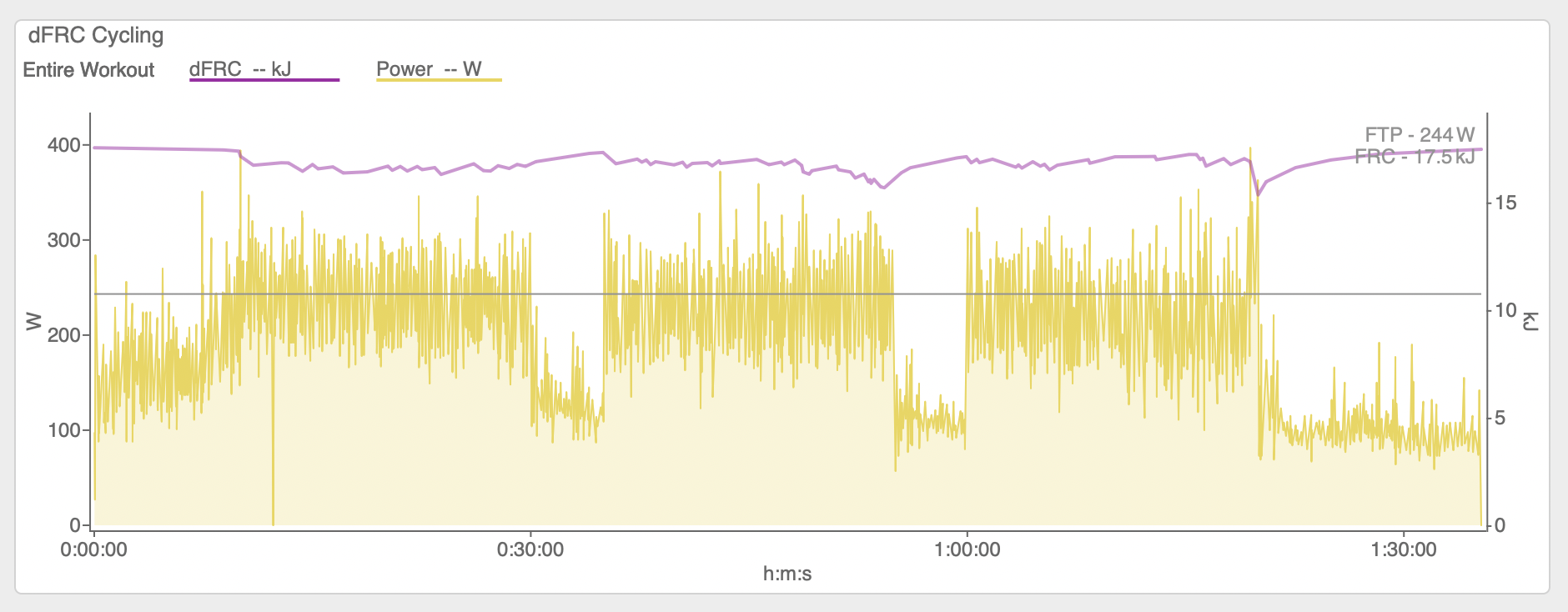
Rider A, 3 x 20' Z3, no ERG mode. September 2026. FTP 244W, FRC 17.5kJ.
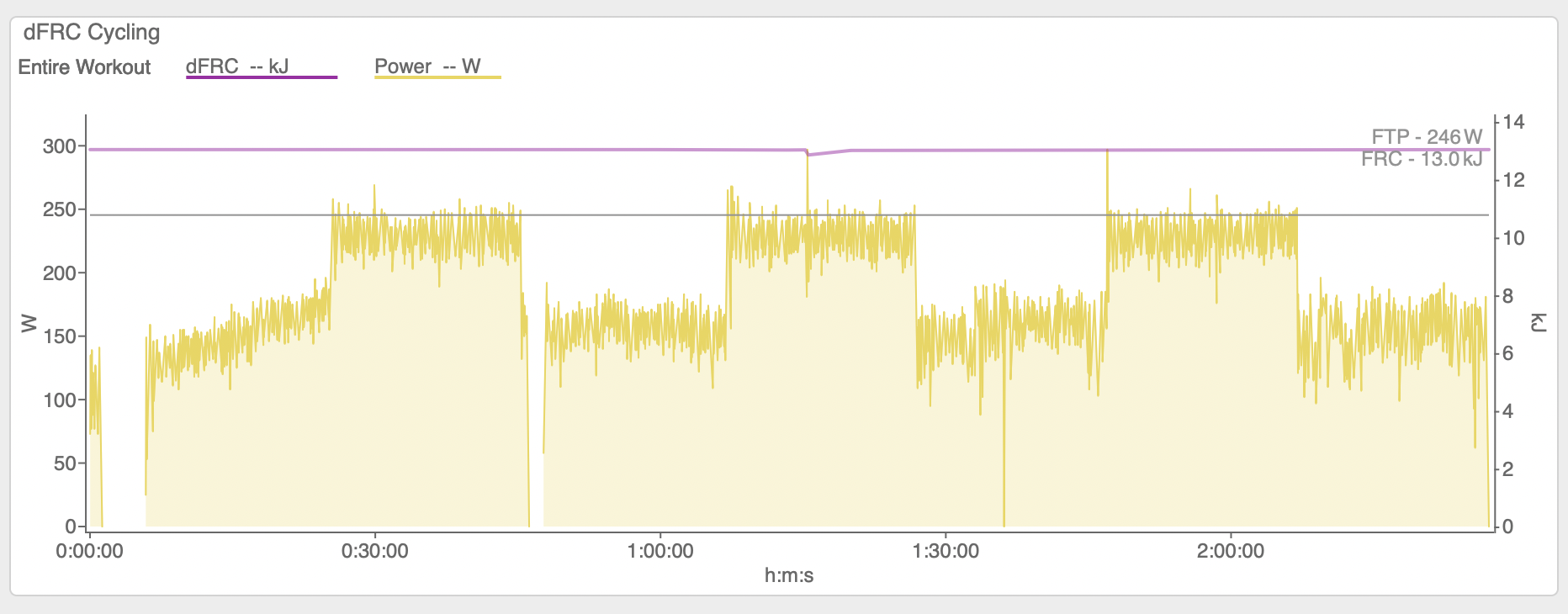
Rider B, 3 x 20' Z3, ERG mode on. FTP 246W, FRC 13.0kJ.
Rider A is doing the regulating himself, and you can see every correction he makes. The power trace never settles. He is in the right neighborhood for the whole block, but he gets there by overshooting and pulling back, over and over, and the purple line moves with him. It dips, recovers, dips again.
The purple line on both charts is W prime: the work you have available above threshold. When it drops, you are spending it.
Rider B is in ERG mode. Three clean rectangles. And then look at the purple line, which is his remaining anaerobic capacity: it does not move. Over two hours, one small notch where he came out of the saddle, and otherwise a flat line across the top of the chart.
Both riders completed the session. Rider B's file is tidier, and if you judged these on the chart alone you would say his was the cleaner execution. But Rider A stayed engaged for the full three by twenty, making a small decision every few seconds and practicing the pacing discipline the whole way through. Rider B had those decisions made for him. Same session on paper. Not the same session.
First, the pros of Watt-Lock
I am not going to pretend this is a close call. For some riders and some sessions, Watt-Lock is the right call. I do not prescribe it, but my athletes definitely choose to use it, and most of the time I am glad they have the option.
The rider with sixty minutes. Riding indoors is what takes the decisions out of that hour. No route, no traffic lights, no warm-up that turns into twenty minutes. ERG then takes the last decision off your plate, because you do not even have to hold the number. You get on, the workout runs, you get off. The session you planned is the session you did.
The rider who cannot ride easy. I have written two articles now about riders who turn endurance rides into something else, and ERG fixes that problem outright. If I need 90 minutes at 200W and I know you will find 36 reasons to go over it, Watt-Lock is the most reliable way to get what I asked for.
Coming back from injury or illness. When the plan says do not exceed a ceiling, I want a ceiling that does not depend on how you feel on the day.
The rider who does not have the skill yet. This is the one people forget. If you cannot hold a power band, telling you to go and practice holding a power band on an open road is not a plan. ERG gives a newer rider a clean stimulus while the skill is still being built, and that is the correct order to do it in.
Weather, light, safety. Not everything is a physiology question. February exists, and when the real choice is the trainer or nothing, the trainer wins every time. ERG is just the feature that makes that hour easy to execute once you are on the bike.
So the problem is not ERG mode. The problem is ERG mode as the default for everything, which is what it becomes, because it is switched on for you and the session runs easier when you leave it alone.
And notice what is not on that list. Threshold work. Go back and look at what a three by twenty in Z3 asks of a rider, and threshold especially. That is exactly where I want an athlete engaged and learning, not reaching for Watt-Lock.
1. You stop paying attention to the effort
When the trainer is holding the number, there is nothing for you to regulate. And when there is nothing to regulate, there is no reason to check in on yourself. So you do not.
You stop listening to your breathing. You stop noticing what your legs are telling you at minute four compared with minute one. You are not asking the question a rider asks outdoors every thirty seconds without realizing it, which is roughly: how is this going, and can I keep doing it?
The session still happens. The adaptation still happens. What does not happen is the learning, and the learning is the part I care most about, because it is the part that compounds.
Here is why I care. On a key workout I want you to feel how you are at 300W. Not read it. Feel it. How your breathing sits at minute two against minute five. What your pedaling is doing, whether it is still clean or whether you have started mashing. Whether it is manageable. Whether you could do more, or whether you should be doing less. Whether you are coming in and out of the saddle just to survive the final minute.
That is the information that tells me how many reps go in the next set, and it is information only you can collect. I can see the file. I cannot feel your legs.
And there is a harder version of the same thing. Somewhere in a hard set there is a barrier, the point where the effort stops being a number and starts being a decision, a mental back and forth conversation with yourself as you negotiate when to stop and when to push on for greatness. Pushing through that is most of what separates a rider who improves from a rider who maintains. That barrier is what decides how many reps and how many sets go in your next block, and you cannot push through one you did not notice because you were reading a text.
I want to put the same asterisk here that I put on the endurance article. I am not saying never do this. There is a time and a place, and the time is most of your week. On an easy spin, on a recovery ride, on the third sweet spot block of a long winter, go ahead and put something on and let the trainer drive. That is a reasonable trade.
It is the key sessions I want your attention on. Those are the ones you are trying to learn something from.
2. You never learn to control your own power
This is the one I see most clearly in files, and it is the reason I wanted to write this.
In ERG mode the trainer sets the resistance and you just pedal. That is the whole job. Outdoors, holding 250W for two hours is a stack of small skills running constantly: shifting before the gradient instead of after it, letting cadence and speed move while the watts stay put, reading the road fifty meters ahead, settling after a corner instead of surging out of it, sitting up or getting low as the wind changes.
Riding inside a tight power band is a skill. It is not a fitness quality and it does not arrive with your FTP.
I spent ten years being paid to hold a number on roads that would not hold still for me, and I can tell you it is not something you are born with. You build it by doing it, badly at first, for a long time. The more the road moves around, the longer it takes.
ERG mode is the version where that practice never happens, because the thing you would be practicing has been done for you.
I see the result in outdoor files from riders who train almost entirely indoors. The band discipline is not there. In the last article I went through a two-hour endurance ride with roughly 36 short efforts over 300W in it, on a rider whose FTP was 200W at the time. He had no idea he was doing them. Not one of those spikes felt like an interval.
That is not a discipline problem and it is not a fitness problem. It is an unpracticed skill. Every one of those spikes is a small failure of gear choice, body position or timing, and none of those get rehearsed by a trainer that holds your number for you.
3. You expect the workout to tell you when you are done
A built workout has a shape before you get on the bike. Five by five minutes, say. You do five, and then it is time to cool down, because the file says so.
But the file was written on Tuesday for a Thursday that had not happened yet. It does not know you slept badly, or that you slept brilliantly. It does not know that the fifth effort was your best one.
Hunter Allen and Andrew Coggan deal with this well in Training and Racing with a Power Meter, and the idea has stuck with me. Rather than counting reps, you judge the set by what is happening to your power. The benchmark is the third effort, not the first, because the first two are usually still finding the rhythm, and you are fresh. Once your power falls far enough below that third effort, the useful work is over and you are just accumulating fatigue.
These are the drops I work to. They are my own numbers, built from the principle above and from a lot of files, so take them as how I coach rather than as a law:
| Interval length | Stop when power drops below the third effort by |
|---|---|
| 20 minutes | 3 to 5% |
| 10 minutes | 4 to 6% |
| 5 minutes | 5 to 7% |
| 3 minutes | 8 to 9% |
| 2 minutes | 10 to 12% |
| 1 minute | 10 to 12% |
| 30 seconds | 12 to 15% |
So on a five-minute set: your third effort averages 320W. When an effort comes in at 298W or lower, that is your signal. Not the rep count. The watts.
Notice what this does in both directions. It stops you grinding out two more junk efforts that you feel on Friday or Saturday and that bought you nothing. And it stops you climbing off with something left in the tank because the workout ran out.
That second one is the part ERG mode quietly takes from you. Maybe you had a sixth five-minute effort in you on Thursday. A good one. But the workout ended, the cool-down started, and you will never know, because nothing asked you.
Do that for two years and you have a rider with a decent engine who has no idea what they are capable of on a good day. I would rather coach a rider who knows.
And the flat hold may not even be the better stimulus
I went into this expecting to write that ERG mode is a clean stimulus with a skill cost. Then I went and read the interval literature properly, and the picture is more interesting than that.
Start with what I am not claiming. I am not telling you a bumpy power file is better for you than a smooth one. I spent the whole of the last article arguing the opposite, that the surges cost you more than the same watts held steady, and I am not about to reverse that here.
But for VO2max work specifically, something different is going on, and it goes directly at the place where ERG mode is supposed to be strongest.
Bossi and colleagues took 14 well-trained cyclists through two sessions of six five-minute intervals. Same duration, same average power, same recoveries. One version held a flat 84% of maximal aerobic power, the way ERG mode would. The other put three 30-second surges inside each interval and dropped the rest of the interval lower so the average matched.
The flat version produced 286 seconds above 90% of VO2max. The surging version produced 410 seconds.
About 43% more time in the range that drives the adaptation, from the same work, at the same average power. Heart rate, lactate and perceived exertion came out the same across the two. The riders did not even pay for it.
One caveat so you do not run too far with this. It holds for the longer intervals. The same idea has been tested on 60-second bouts and nothing came of it, which makes sense, because a one-minute effort does not give your oxygen uptake the room to respond to anything you do inside it. So this is a point about three, four and five-minute work. It is not a reason to go changing your 30/15s.
What it means in practice is that the perfectly flat five-minute interval, the one ERG mode exists to deliver, is probably not the best five-minute interval available to you. A rider going by feel, who starts a bit over, settles, and lifts again when they can, is accidentally doing the better protocol.
One more thing, while we are here
The numbers you produce indoors are usually not the numbers you produce outdoors, and the gap is bigger than most riders think.
High North's review of the literature is the best summary I have found. The honest answer is that it depends heavily on your setup and how used to the trainer you are, but for riders who train regularly both indoors and out, something in the region of 5 to 10% lower indoors is a fair working figure. For riders who rarely ride inside, more.
And it is not only in your head. Several of the studies they cover point to physiological rather than motivational causes: less airflow, so more of your capacity goes into getting rid of heat; a fixed bike with no upper body input and often a nose-down position; resistance applied through the whole pedal stroke instead of the dead spots you get on the road; and a tendency to sit at a higher cadence indoors.
The practical consequence is simple. If your FTP was set inside and your ERG workouts are built off it, those targets may be soft for outdoors. The reverse catches more riders out: an outdoor FTP driving indoor ERG targets gives you a session you cannot complete and a trainer that is about to drag you into the spiral of death while you wonder what happened to your form. This is your coach's job, to make sure the targets you are given are prescribed accurately in the first place.
What it looks like when a rider uses both
Now go back eleven months, to before the file at the top of this article. Same rider, October 2025, on a big lactate threshold session. He started it self-paced and he finished it in ERG mode. It is the best illustration of this whole argument that I have in my files.
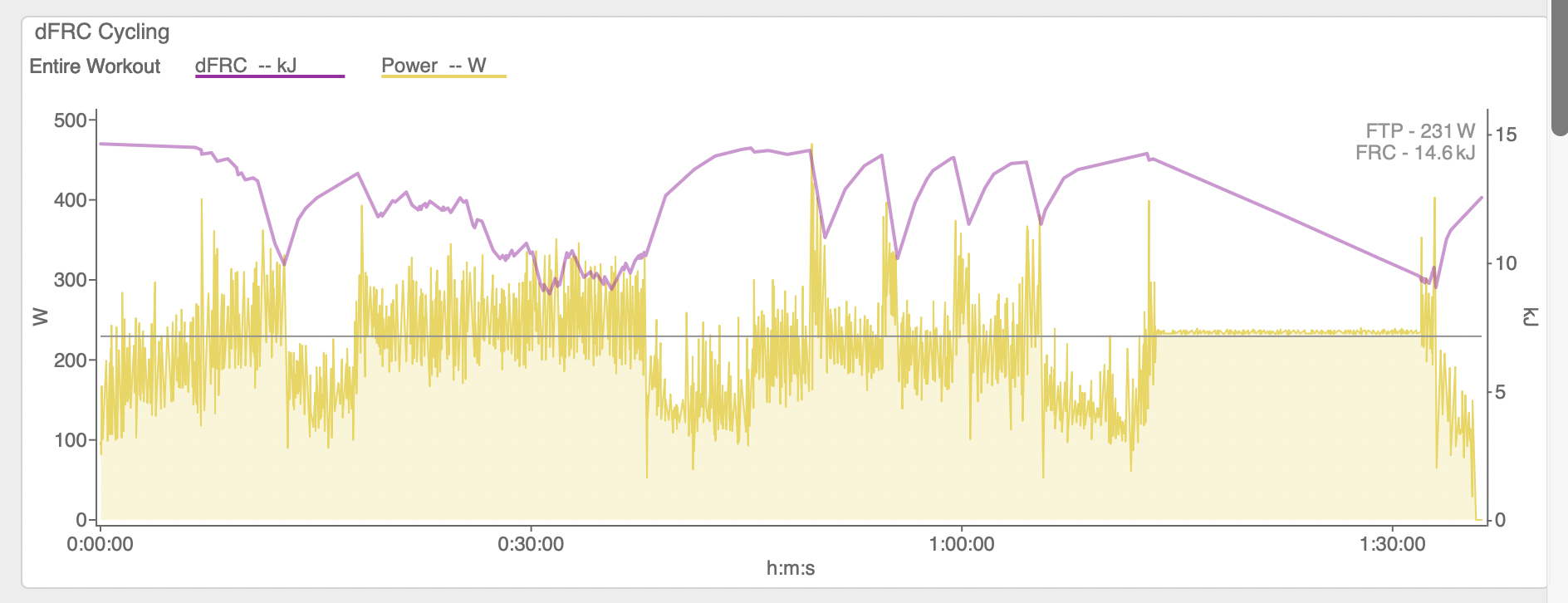
Same rider, October 2025. A long LT session, self-paced for most of it, ERG mode switched on for the last block. FTP 231W, FRC 14.6kJ.
Look at the purple line across the first part of the session. It is a sawtooth. Down hard, back up, down hard, back up. That is a rider spending his anaerobic capacity and then getting it back, over and over, because he is the one deciding when to push and when to ease. Those deep dips in the middle are the one-minute standing efforts.
Then he switches ERG on, and two things change at once. The power trace goes ruler-flat, the way it does. And the purple line stops sawtoothing and starts descending in one smooth, unbroken slope. No dips. No recoveries. Just a steady drain from the top of the chart down, because the trainer has stopped giving him the choice.
Here is what he wrote on the file afterwards:
What a MONSTER trainer lap today. Had a hard time convincing myself to clip in but as soon as I did I was sooo thankful that I did. I felt amazing today! First 20' was glorious. I could've kept holding that pace or done a higher 20' power likely.
2nd 20' block was harder to get the rhythm at first and then those 1' standing efforts drained my W'. I could feel it! Surprisingly I was able to hang on for that 20'.
3rd 20' was by far the most grueling part of this workout for me tonight. Probably because of my mental resistance and accumulated fatigue from work and the early part of this workout. I turned on ERG and just tried to survive the 20'.
Fueling: I did 225g of carbs during this ride. Treated it like a race. 3 bottles in total. Stomach fought back a bit towards the end but overall this seemed to go well!
I am proud of this effort for a Tuesday night.
Read that first paragraph again. I could've kept holding that pace or done a higher 20' power likely.
That sentence is worth more to me than the session was. He now knows something about himself that was not in the plan and could not have been, and the only reason he knows it is that he was the one holding the power. A rider in ERG mode for that block finishes it, ticks it off, and learns nothing about himself. The work got done and nothing got learned, and across a season that gap is enormous. The number was the number. It was always going to be.
Then look at the second one. Those 1' standing efforts drained my W'. I could feel it. He felt his W' going. The chart agrees with him, and you can see the exact dips he is describing. That is a rider who is in the session rather than next to it.
And then the third block, where it fell apart, and he turned ERG on and survived it.
That is not a failure. That is the correct use of the tool. He had already taken what the session had to give him. His head was gone, work had drained him, and the remaining job was to get the twenty minutes done. Watt-Lock is very good at getting twenty minutes done.
That is the whole argument, in one Tuesday night file. Self-pace while there is something to learn. Switch it on when there is only work left.
One last thing about him. The 3 x 20 at the top of this article, the messy self-paced one, is the same rider eleven months on. In October 2025 his FTP was 231W. By September 2026 it was 244W.
I am not going to tell you that self-pacing bought him those watts. A year of training bought him those watts, and I would have to run a trial I am never going to run to separate the two. But I will point out the thing I noticed when I lined the two files up, which is that his file got messier and his rider got better.
Rider A is Kevin, and those are FTP numbers, which sit below the 20-minute figures people usually quote. If you want the full version of that build, I wrote it up separately: 20-minute power from 207W to 261W in 19 months, on 10 to 14 hours a week around a 50-hour work week.
That is the tension I want to leave you with. The ERG file looks better. It is tidier, it is more compliant, and if you judge your training by how the chart looks you will keep choosing it. The rider holding his own power produces a worse-looking file and comes away knowing something.
So what do I tell riders to do
Leave ERG on for the sessions where compliance is the point. Easy rides where you tend to go too hard. Recovery spins. Anything on a day when your head is not in it and getting the work done is the win. This is a real part of your winter and there is no shame in it.
Turn it off for your key VO2max and threshold work. I want you to feel threshold, not be held at it. Switch ERG off, pick your gear, and hold the effort yourself. Expect to be worse at it than you think. That is the point of doing it.
Turn it off for anything under about a minute. Sprints, 30/15s, short on-offs. The trainer cannot respond fast enough and you spend a chunk of every effort waiting for it. Pick a gear and go.
Run one self-paced interval set a week and judge it by the third effort. Do your first two, then treat the third as your benchmark. Keep going until your power falls below it by the margin in the table above, then stop, whether that is at four efforts or seven. Write down what number you held and how it felt. You are building a reference you do not currently have.
Stop looking at the screen for one interval. Cover it if you have to. Do a five-minute effort on breathing and legs alone, then look at what you did. The gap between what you guessed and what you produced is the thing you are trying to close, and it closes quickly once you start checking. Imagine your Garmin decides to crash on the morning of Nats TT. You need to be within 10 to 20W of how that effort feels, or your race is a disaster. I want a rider to know how any given power range feels.
Raise your cadence before the interval, not during it. This is the practical defense against the spiral. Start the effort a few rpm higher than you want to finish it so you have somewhere to fall.
Check whether your indoor and outdoor numbers agree. If your last two FTP tests were both on the trainer, your outdoor targets are a guess. Test outside once, or at least compare a hard outdoor hour to what you can hold inside.
Go and ride outside on the key days when you can. ERG mode is a good tool for doing the work. It is a poor tool for learning what you can do. Those are different jobs and you need both.
The riders I see make the biggest jumps are rarely the ones who found a better workout. They are the ones who learned to read themselves well enough to know when a session had given them what it had to give.
That is a skill. You cannot outsource it to a trainer, and the trainer is very happy to let you try.
If you want someone going through your files with you, book a free 30-minute call and we will look at your last month together.
Resources
- Bossi AH, Mesquida C, Passfield L, Rønnestad BR, Hopker JG. Optimizing interval training through power-output variation within the work intervals. International Journal of Sports Physiology and Performance, 2020.
- High North Performance. Indoor FTP vs outdoor FTP: why they feel (and are) different.
- Allen H, Coggan A, McGregor S. Training and Racing with a Power Meter, third edition. VeloPress.
- Related reading: Kevin's 54W case study · How long should your endurance rides be? · Why you're tired after an easy ride · Zone discipline