
What I look for in an endurance file, and two riders whose numbers show why the summary screen will not tell you.
Part of my job is putting the right stress on a rider at the right time, so that the right things adapt. That part is reasonably straightforward. The harder part is doing it without changing how you want to ride your bike.
I do not want an athlete staring down at a power meter, pushing the lap button over and over, waiting for a session to be done with. Most of us ride because we like being outside. New roads, good company, a new coffee shop, a few hours where nobody can reach you. A lot of endurance riding fits straight into that, which is lucky, because it means we can train the thing and keep the reason you started at the same time.
So when I talk about endurance rides, I am really talking about three different things.
The physiological one. This is the ride with a job. We are pushing the aerobic ceiling and driving efficiency at a cellular level, and for that the execution actually matters. This is the one I want the rider focused on their zone discipline. I went through the research behind it separately. This is the ride I will pick apart in a file review, and it is the one the rest of this article is about.
The one with the group. Drafting, holding a wheel, riding close to somebody at speed, taking a turn and getting back on. Those are skills, and you do not learn them on your own. The power band will not be clean and that is fine. It is still a long ride, you are still being social, and you are still putting quality hours on the bike.
The one that is just a ride. You have had a hard week at work and you want to go and ride. Not high Z2, not low Z2, not worrying about Z1 on the descents or a bit of tempo on the climb. Just riding, because that is why you have a bike in the first place.
All three are endurance rides. My job is to know which one we are doing on a given day, to sprinkle them through a week in a ratio that matches what you are actually training for, and to leave you the room to choose for yourself on the days it does not matter.
With a junior, the ratio leans toward the second one. Skills, group riding, time in a bunch, sitting on top of an aerobic base we build slowly over years.
With the rider whose August file I am about to show you, it leans the other way. We started working together at the end of July, and the biggest return available to him right now is learning to pace. Sorting out those spikes will do more for his recovery and his endurance than any session I could write for him. But not at the cost of the weekend rides he does with his partner. Those stay where they are.
A rider sent me a three and a half hour ride this week. Average power 294W. His endurance band is 249 to 339W, so that average sits almost exactly in the middle of it.
It was meant to be the first kind. It was not.
I review a lot of files. I would not say I look at endurance rides harder than anything else, but I do pay close attention to them, and most of the time it is the athlete who sends me there. Somebody tells me they were tired after a two-hour endurance ride. That is the comment that puts me in the file, because a two-hour endurance ride should not leave you tired. Then I go and find the thirty-odd spikes that explain why it did.
A bad interval session announces itself. A bad endurance ride looks fine on the summary screen and quietly costs you the next two days.
So here is what I go looking for.
The average is the most misleading number on the page
The first thing I do with an endurance ride is ignore the average.
An average tells you where the middle of the ride was. It tells you nothing about whether the ride ever spent time there. Two hours of surging and soft-pedalling averages out to the same number as two hours of riding properly, and on the summary screen they are identical.
So I count pedal strokes instead. How much of the ride was actually inside the band, stroke by stroke, with the coasting thrown out?
On that 294W ride it was 38%.
Thirty-eight percent. The other 62% of the time he was either above the band or underneath it, and the two sides cancelled each other into an average that looked perfect. I want to see more than 60% before I am happy with an endurance ride. Under half and the session was something else wearing an endurance ride's name.
His heart rate backed up the average too, by the way. 85% of the block sat in Z2 heart rate. If I had only looked at heart rate I would have signed the ride off and moved on. This athlete was also deep in a training block, meaning his HR was even slower to react than usual given the fatigue.
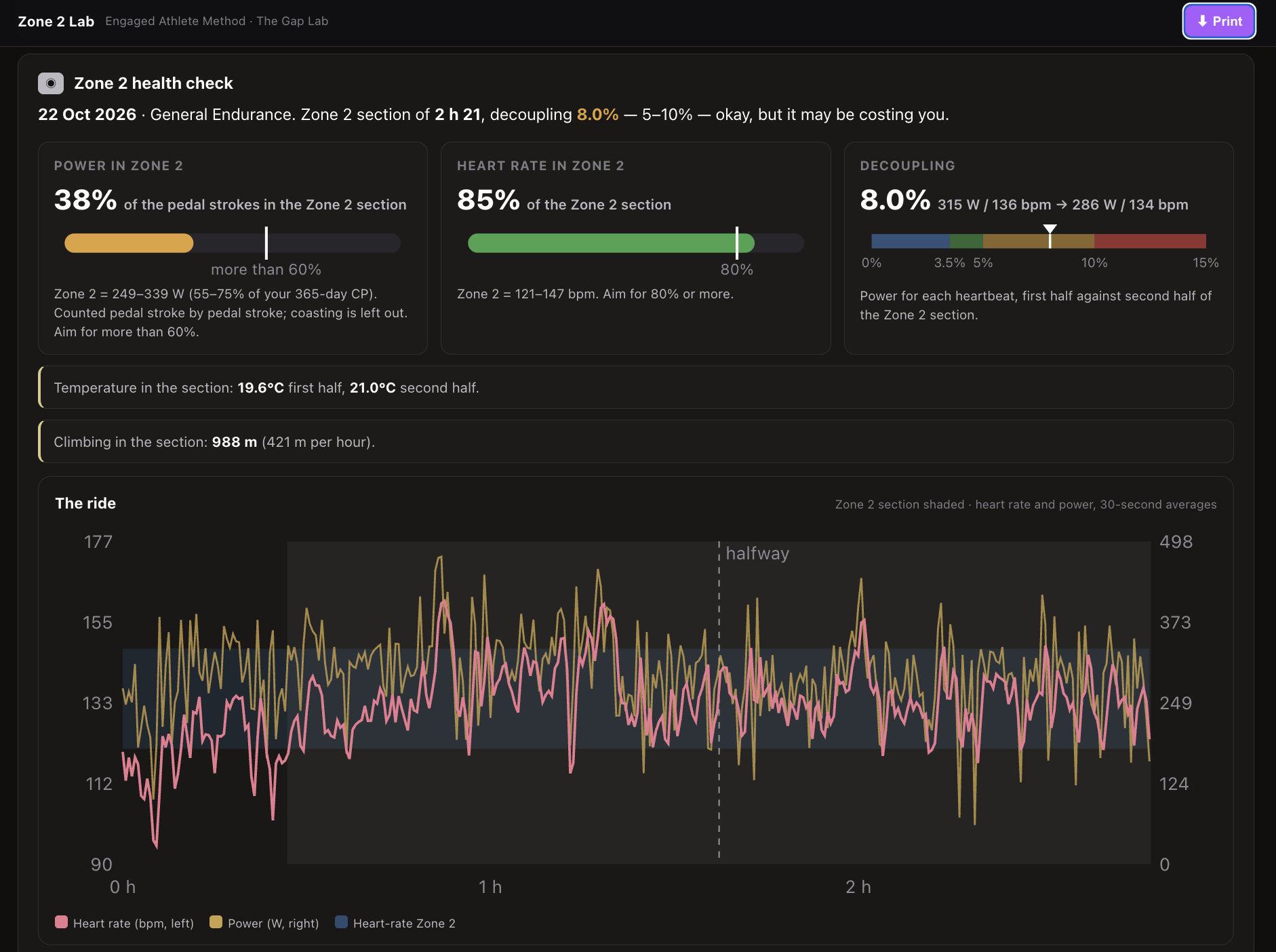
2 hours 21 minutes of endurance riding: 38% of pedal strokes in the Zone 2 power band, 85% of the block in Zone 2 heart rate, 8.0% decoupling. Analysis done using the BATS Network Coach Dashboard.
Then I count how many times you left it
Different rider, different problem. This one is from August.
A two-hour endurance ride with roughly 36 short efforts over 300W in it. His FTP at the time was 200W. Most of those efforts were a few seconds long, which is exactly why he had no idea he was doing them. Not one of them felt like an interval. A rise out of a corner, a gap to close, a short steep bit he did not want to shift down for.
Here is what I wrote on the file, more or less word for word:
If you ever wonder why you're feeling tired after a basic Z2 ride, check this. I counted roughly 36 short efforts where your power exceeded 300W+. The graph almost looks like you raced a crit with short accelerations out of each corner lap after lap.
This wasn't an issue for today, as it's good training. It does, however, mean this ride was much more than just a basic Z2 endurance ride. You accumulated 5mins in SupraMax, 260W+, today. Those little spikes add up quickly!
See if you notice anything particular during your next outdoor ride. Are you riding steady, or do you notice you unintentionally surge quite a bit. You can always set your Garmin to show your 3-second power instead of 1-second. That smooths out the power you see on the screen a little bit more, and can make it feel easier to hold a constant power than trying to make a 1-second power number sit on 120W.
I uploaded a screenshot for you to see what I see when I refer to a crit-file. Yellow is power, purple is your W'. Each time you go over CP that purple line dips.
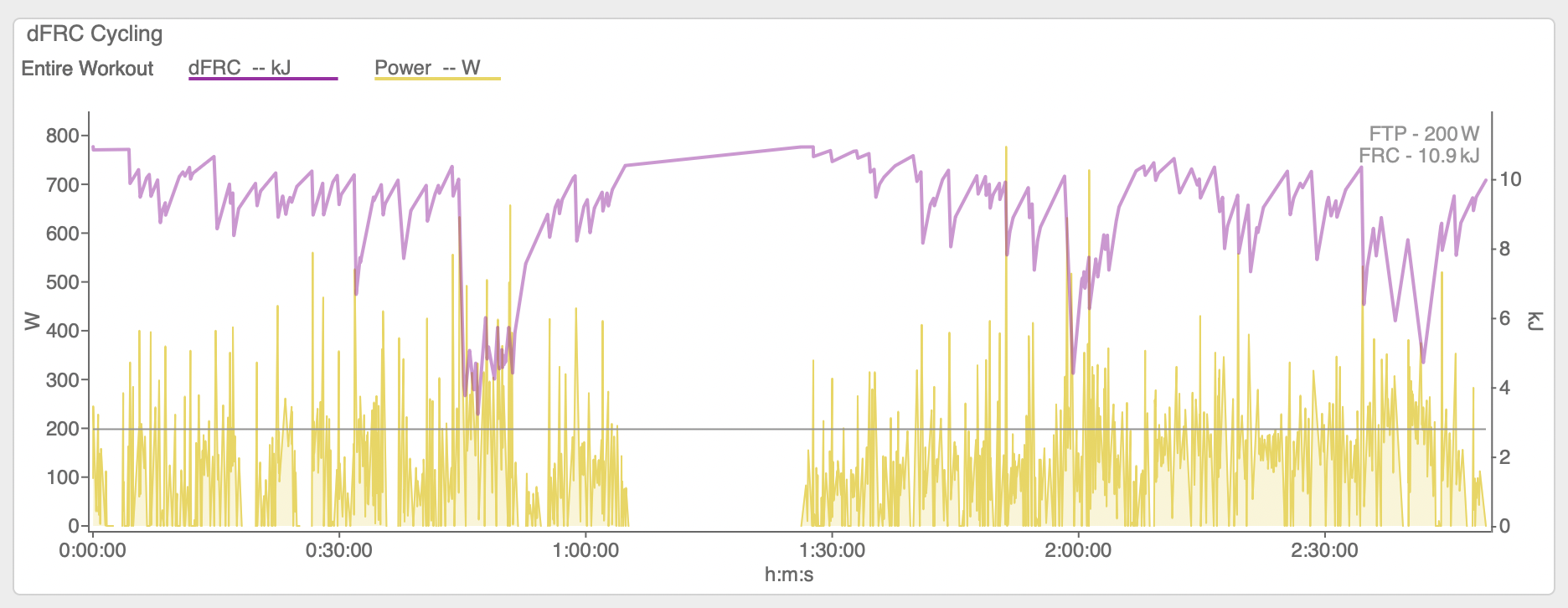
August. Yellow is power, purple is W’. Every dip is a short effort over CP.
That purple line is the thing. He starts the ride with 10.9kJ of W' in the tank, and by the middle of the ride he is down around 3kJ.
He spent about 70% of his anaerobic capacity on a session that was never meant to cost him any of it.
Notice I did not tell him he had ruined anything. He had not. It was good training. It just was not the training that was on his plan, and the bill for it arrives on Tuesday instead of Sunday. Those efforts are too short to feel like anything at the time, and that is the entire problem with them.
What it looks like when a rider fixes it
Then I left it with him. The last thing I asked was whether he would pay attention on his next ride and see if he could catch himself doing it.
Here is the same rider on 7 October, riding the same kind of session. His W' balance never drops much below 11kJ of 12.7. It sits near the top from the first minute to the last. The power trace is flat. The spikes are gone.
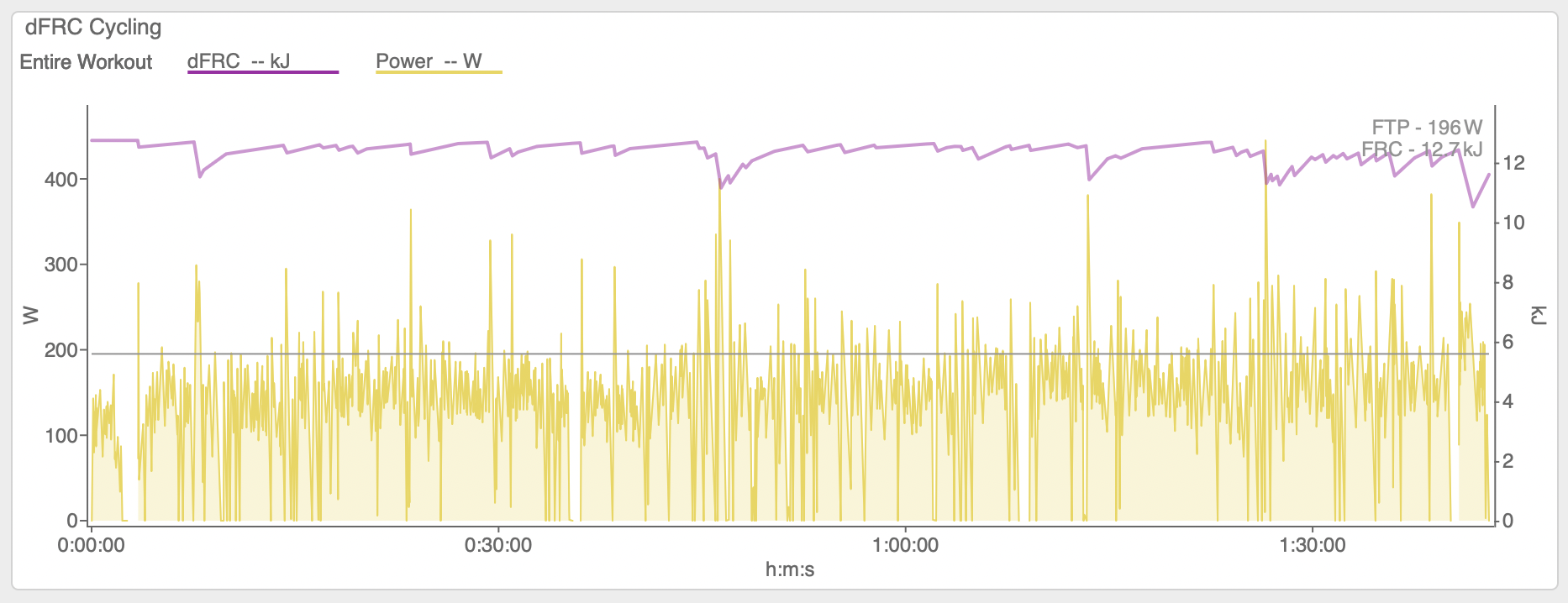
Seven weeks later. Same rider, same kind of session, W’ barely leaves the top of the range.
His threshold sits in much the same place across the two files, 200W in August against 196W in October. He has made real gains in those weeks, but none of them explain the second chart. His W' is bigger now, 12.7kJ against 10.9, so he has more of it available than he used to and he is spending far less of it. The pacing is what changed.
That is the whole reason I keep going on about this. It is not a fitness problem and it does not take a block of training to fix. It takes a rider deciding to stop chasing the short bits, which is a harder ask than it sounds, and about six weeks of actually doing it.
Then I ask where the drift came from
Back to the 294W ride. His decoupling was 8.0%, with power per heartbeat falling from 315W at 136bpm in the first half to 286W at 134bpm in the second.
On its own that is a good number. Drift is what I am looking for on a long ride. It means the ride got far enough into the day to actually do something.
But drift can be earned or it can be bought, and they are not the same thing.
There was 988m of climbing inside that block, at 421m per hour. He paced every one of those climbs too hard. Not hugely, and not with a sprint, but he held his speed up the gradient instead of letting the speed drop and keeping the watts where they belonged. Then he crested and went straight back into Z2 with no settle at all.
That is the small thing I am looking for, and it is the hardest habit to break in a rider who likes chasing Strava KOMs. Letting your speed fall on a climb feels like giving something up. It is the whole skill.
So some of his 8% came from the hours, which is the signal we went looking for. Some of it he bought on the climbs, which is just a cost. This is why I will not sign off an endurance ride on decoupling alone. The number does not tell you which kind you got.
What I tell riders to do about it
Pick the road before you pick the ride. This is the one that fixes the most files. If the route has punchy climbs on it you will ride them, because everybody does. Flatter and quieter is not a boring choice, it is the choice that lets the session happen.
Let your speed drop on the climbs. Hold the watts, lose the speed, shift earlier than feels necessary. If you have to get out of the saddle to hold a gear on an endurance ride, you are in the wrong gear. Back in the day when I was training as a World Tour rider, I allowed recreational riders to pass me up a climb. If my job was to ride at 220-280W, and I'm sitting on 280W while someone else is pushing 320W, I allowed them to pass me. That's the zone discipline I keep on referring to.
Decide which of the three it is before you leave the house. If today is the physiological one, ride it on your own. A group ride is still an endurance ride and I want them in your week, it just will not hold a clean band, and the two do not substitute for each other.
Fuel it from the start. 60 to 90g an hour, beginning inside the first 45 minutes. Riders who get to hour four empty do not ride hour four properly, and then they are flat on Tuesday.
Switch your head unit to 3-second power. A 1-second number jumps around so much that you end up chasing it, and chasing it is how the surges get in. Three-second smooths the display enough that holding a steady 120W feels like holding something rather than wrestling it.
Check your own file afterwards. Percentage of time in band, number of times you crossed threshold, where the W' balance finished. Three numbers, two minutes. You do not need a coach to look at those, you just need to look.
Neither of those riders was slacking. That is the thing worth saying plainly. Both of them were working hard enough to be tired. Both of them were riding more than most people would. They just were not riding steadily enough to get what they went out for, and nothing on the summary screen was going to tell them.
If you want the physiology behind why the long ride matters in the first place, I wrote that up separately. This one is just what I look at.
And if you would rather have someone else looking at your files with you, that is my job I love doing. Book a free 30-minute call and we will go through your last month.