
The short version
If you want one number, it is three hours.
That is roughly where most trained riders start to reach the state that makes a long ride a long ride. Your slow-twitch fibres run low on fuel. Your body starts asking other fibres for help. Your heart rate climbs while your power sits still. That state is the stimulus, and you cannot get there in 75 minutes no matter how hard you ride.
But the clock is just a guide, not a rule. The real marker is whether your heart rate starts drifting away from your power late in the ride. If it drifts, the ride was long enough for you. If it never does, you need to go longer, or look at your HR data to see if you were riding hard enough.
One genuinely long ride a week will build it. Two is better if your recovery and your life allow it.
What changes when a ride gets long
Early in an endurance ride you are riding mostly on type I fibres. They are efficient, they are happy burning fat, and they are the fibres that decide whether you are still strong four hours into a race.
Those same fibres empty first. The classic muscle biopsy work from the 1970s and 80s showed that during prolonged steady riding, glycogen comes out of type I fibres preferentially, and that after three hours at low intensity what glycogen is left in the muscle sits almost entirely in the fast-twitch fibres you were not trying to train. Short hard efforts do the opposite. They reach into type II fibres first. That is why a 40-minute threshold session can leave you completely cooked without ever putting your slow-twitch fibres into the state a long ride puts them in.
Once type I fuel runs low, something has to carry the work. You start recruiting higher-threshold motor units to hold the same watts, and those fibres are less economical. The same 220W now costs more oxygen, more heart rate and more fuel.
That is the drift you feel in hour three. It is not the ride going badly. It is the ride working, and that deterioration over time is what researchers now call durability.
Why a hard hour is not a substitute
This is where most riders get it wrong, and I include my younger self in that. Intensity and duration are not two roads to the same adaptation. They build different things.
When researchers pooled the training studies, the split was clean. Training volume is what drives mitochondrial content, which is how many mitochondria you have. Training intensity is what drives mitochondrial respiratory function, which is how well each one works.
So your VO2max session and your four-hour ride are not competing for the same job. One sharpens the engine. The other makes it bigger. If all you ever do is the hard hour, you are sharpening a small engine very well.
I want to be straight about one thing, because the internet version of this argument overreaches. If you measure the acute molecular response in the muscle after a session, short hard efforts often produce as much as a long ride does, and sometimes more. The case for long rides is not that they shout louder at your cells. It is that they are the only way to arrive at a specific state: type I fibres low on fuel, recruitment shifting, hours of accumulated load in your legs. Nothing short gets you there, however hard you push.
So how long is long enough?
No study has found a magic threshold at three hours. I want to say that plainly, because the number gets quoted like it is a law. It is not. It is a reasonable average for trained riders, and it comes out of the glycogen work above rather than from a trial that compared 2:45 against 3:15.
The better test is individual, and it is the one Stephen Seiler keeps pointing people back to. Look at the back half of your ride and ask whether your heart rate has climbed away from your power at the same effort. If it has, that ride was long enough for you. If you finished at the same heart rate you were holding at 45 minutes, you never reached the state you went out for.
That scales properly, which is why I use it. For a rider in their first season, the drift might show up at 100 minutes, and 100 minutes is their long ride. For a strong junior like Bennett, it takes well past three hours of real work before anything interesting starts happening. Same marker, different duration.
As a starting frame: a newer rider builds toward 90 minutes to two hours. A fit amateur racing road or gravel wants three to four. If your event is five hours long, you need a handful of rides that take you past four before race day, because the last hour of that event is a place you have to have been.
The other half of the question: how hard?
Duration is only half of it. The intensity you hold decides whether those hours do what you think they are doing, and it is where I spend a lot of my coaching attention. As easy as an endurance ride is supposed to be, there is an art to it, and painting it right is the coach's job. I wrote about zone discipline back in 2019, and nothing about the problem has changed since.
Endurance has a range. I work with 55 to 75% of FTP, and both ends of that range matter.
Ride below it and you leave most of it on the table. Three hours is still three hours, and that time on the bike counts for something. But if your heart rate finishes where it started, you never reached the state that makes a long ride worth the morning. The ride was not wasted. It just was not the session you thought you were doing.
Ride above it and you are in tempo. Your heart rate climbs in the first hour instead of the third, and the recovery cost climbs with it. A long endurance ride is not the cheap session of your week. It is usually the biggest one you do and often the most important (depending on the time of the season). But it should cost you hours, not matches. Ride it at tempo and you pay in both, and the quality session two days later is the one that suffers.
Terrain decides more than most riders realise. Ride a route with punchy climbs and chase a KOM up each one, and you have changed the metabolic cost of the whole session. On paper it is still a three-hour endurance ride. In your legs it is an interval session with a very long warm-up, and it will not give you what you went out for.
Here are two files from riders I coach, both of whom I had a direct conversation with about this.
The first one is about spikes. A two-hour endurance ride in August with more than 30 efforts above his 200W threshold, most of them only a few seconds long. None of them felt like intervals to him. You can see what they cost on his W' balance: it starts the ride full at 10.9kJ and by the middle of the ride it has been drawn down to around 3kJ. He spent roughly 70% of his anaerobic capacity on the session that was meant to be the cheapest one of his week.
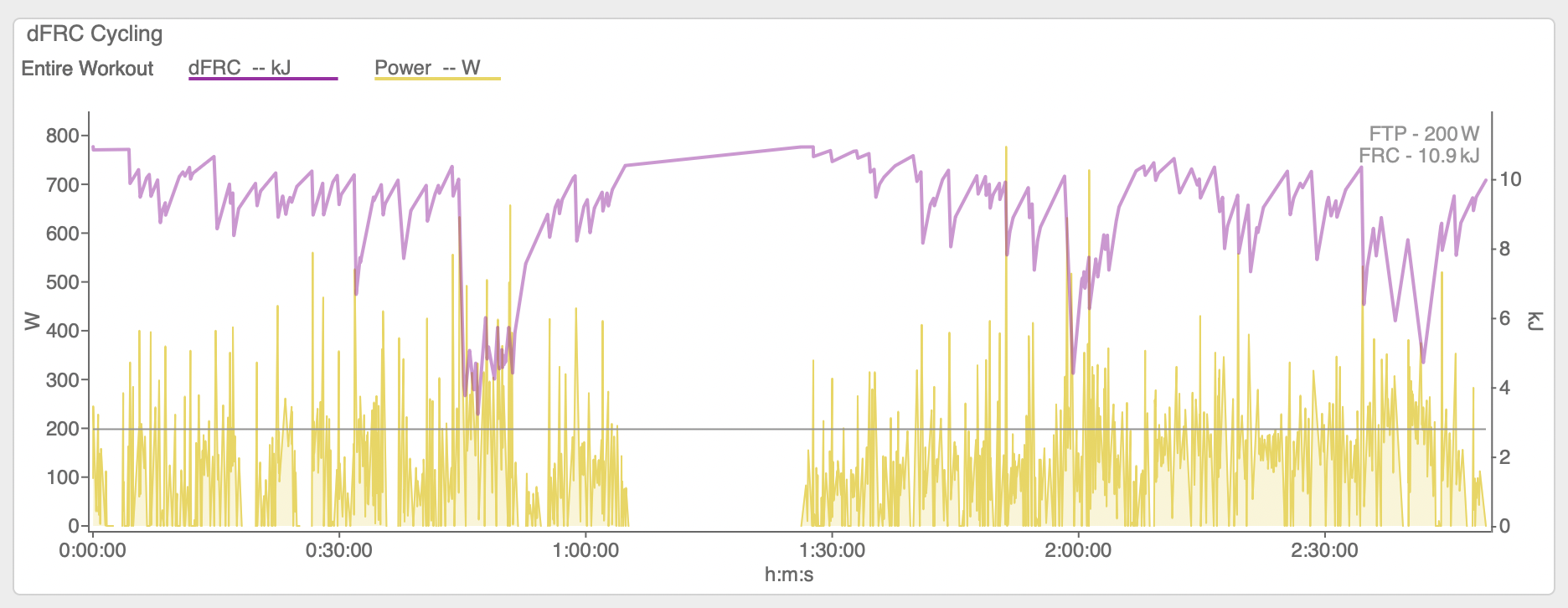
August. Every dip in the purple line is W’ being spent on a ride that was supposed to be easy.
We talked about it. More than once. His file from 7 October is the same rider riding the same kind of session, and his W' balance never drops much below 11 of 12.7kJ. It sits near the top from start to finish. The power trace is flat, the spikes are gone, and the ride finally costs what an endurance ride should cost. His threshold is essentially unchanged between those two files. What changed is how he rides.
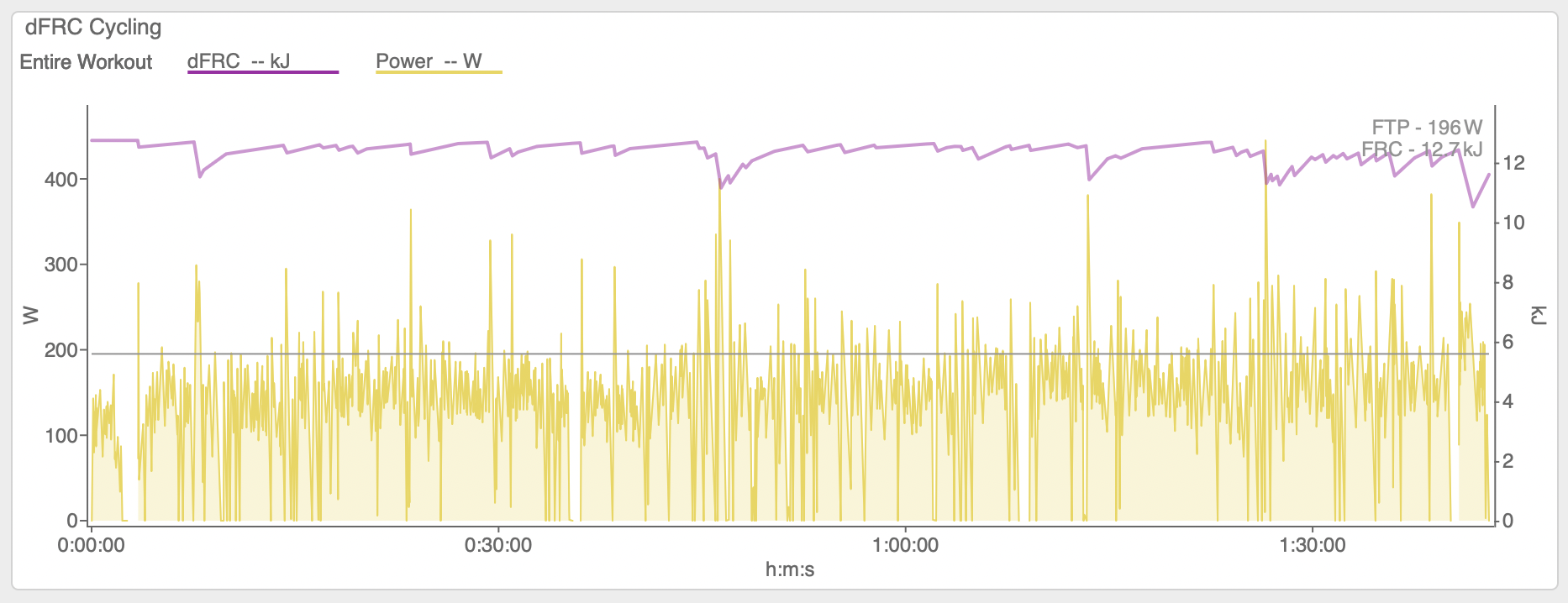
Seven weeks later. Same rider, same session, W’ barely leaves the top of the range.
The second one is about distribution, and it is the more common problem. Yesterday a rider sent me a three and a half hour general endurance ride with a 2 hour 21 minute endurance block inside it. His endurance band is 249 to 339W. His average power for the ride was 294W, which lands dead centre in that band. Judged on the average alone, it is a perfect endurance ride.
Only 38% of his pedal strokes were actually in that band.
His heart rate agreed with the average: 85% of the block sat in Z2 heart rate, which reads like a well-executed session. The power file says otherwise. 988m of climbing inside that block at 421m per hour, a maximum of 959W, and 8.0% decoupling, with power per heartbeat falling from 315W at 136bpm to 286W at 134bpm. The climbs are where it went. He paced them too hard, holding his speed up the gradient instead of letting it drop and keeping the watts in his band, then went straight back to Z2 the moment he crested. He was not coasting and he was not slacking. Heart rate smooths all of that out. Power does not.
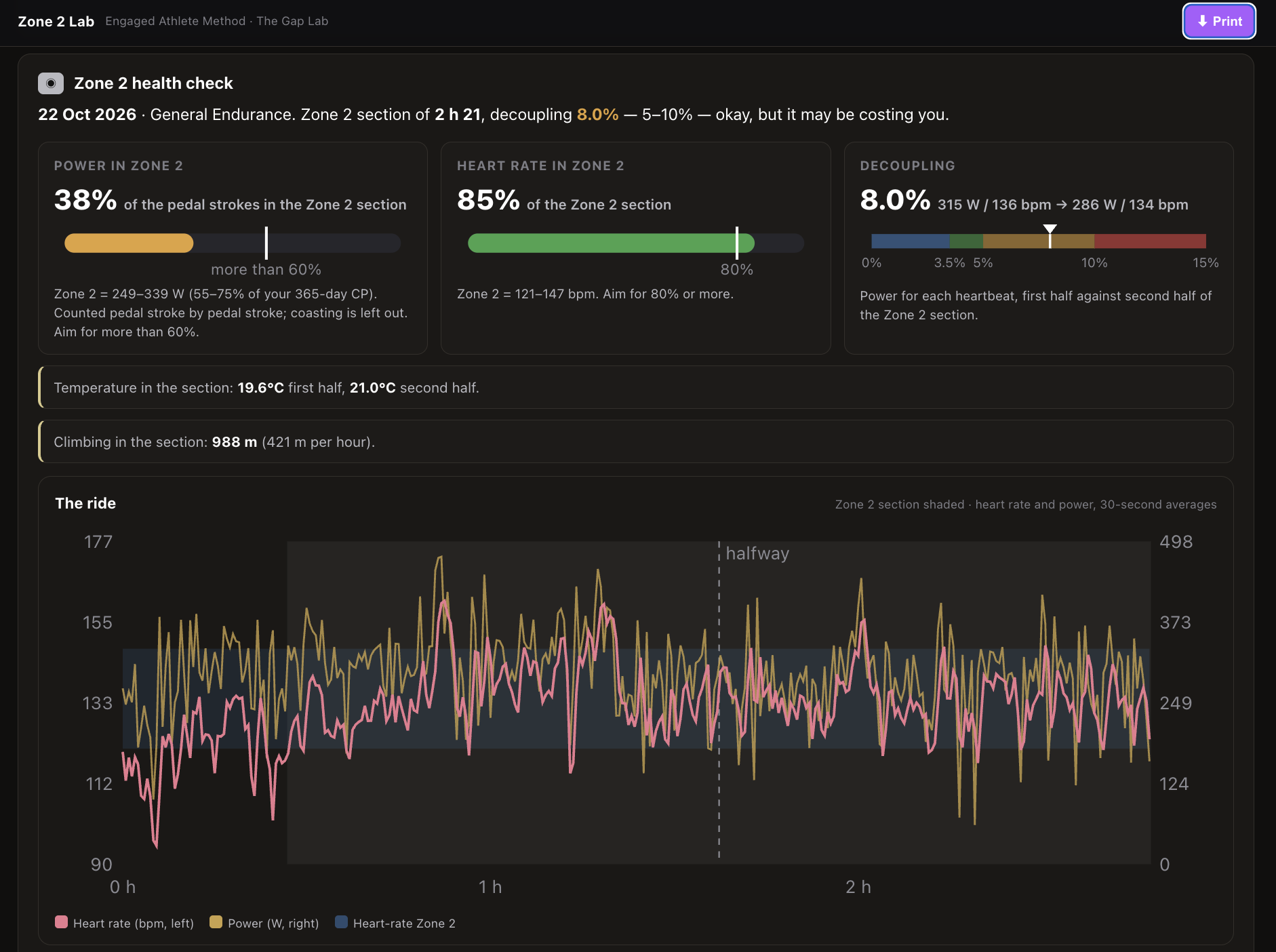
2 hours 21 minutes of endurance riding: 38% of pedal strokes in the Zone 2 power band, 85% of the block in Zone 2 heart rate, 8.0% decoupling. Analysis by BATS Network Coaching Tool.
This is also why I will not judge an endurance ride on decoupling alone. Some of that 8% came from the hours, which is the signal we went looking for. Some of it he bought on the climbs, which is just a cost. Drift you earn from duration is the adaptation. Drift you pay for with efforts is a tempo ride wearing an endurance ride's name.
Neither rider was slacking. Both were working hard enough to be tired and not steadily enough to get the adaptation, which is the most common way I see endurance rides fail. If you want to audit your own, open the file and look at three things: how much of the ride was actually in Z2 power, how many times you went above threshold, and whether your W' balance finishes the ride near where it started. Then pick flatter, quieter roads and ride the session you planned.
How often do you need to do it?
Once a week is the floor. Twice is where it starts to move quickly, if your recovery can carry it.
The best real-world evidence I know of comes from a season of under-23 professionals. Time spent below the first ventilatory threshold, meaning genuinely easy riding, correlated with improvements in the power those riders could produce after 2,000 kJ of work. The ones whose durability improved across the season were the ones who raised their volume, and the ones whose volume fell away during the racing block lost it.
Then there is the question I get most often from riders with jobs: can I do two 90-minute rides instead of one three-hour ride?
No, and there is research on close to exactly that. One long session was compared against two shorter ones matched for total time and intensity. The long session produced a duration-dependent drift in heart rate, blood lactate and perceived effort, so a higher internal stimulus overall, while the second half of the split day actually came in easier than the first. The same pattern turned up earlier at low intensity in cross-country skiers.
Those studies used runners and skiers rather than cyclists, so I hold the numbers loosely. But the direction matches what I see in power files every week. Two 90-minute rides make a good training day. They do not make a long ride.
What the pros actually ride
Here is the number that surprises most riders I coach. In a 2022 comparison of junior, under-23 and professional road cyclists across a season, average session duration came out at 2.0 hours for the juniors, 2.2 hours for the under-23s and 2.6 hours for the professionals.
So the professionals are not riding five hours a day. Their average day is under three hours. What they do have is one or two rides a week that are genuinely long, sitting inside a week with far more total volume than yours or mine. The long ride is a specific session with a specific job. It is not the whole programme.
The junior number is worth sitting with too. Two hours. Duration gets built over years, not over a winter, and I would rather a 16-year-old arrive at 20 with room still to grow than burn through it early.
How I build it with the riders I coach
Pick the day and protect it. For most of my athletes that is Saturday. It is the session the rest of the week bends around, not the one that gets cut when things get busy.
Grow it slowly. Fifteen to twenty minutes added to the long ride each week, then a week holding steady, is plenty. The riders who get hurt are the ones who jump from two hours to five because an event is six weeks out.
Keep it genuinely easy. If you ride your long ride at tempo you have bought yourself a hard day and lost the next two. The drift should come from the duration, not from your power.
Fuel it from the start. 60 to 90g of carbohydrate an hour, starting inside the first 45 minutes. You will hear people argue for riding the back end empty to force adaptation. The glycogen threshold idea behind that is an explicit hypothesis rather than a finding, and when researchers tested graded reductions in muscle glycogen they did not get the extra signalling the theory predicted. What I see in files is simpler: underfuelled riders are slower in hour four, they recover worse, and they get sick more often.
If you are short on time, consolidate. Put your hours into fewer, longer sessions instead of spreading them thin. Three hours on Saturday plus two quality sessions in the week will beat five 70-minute rides. Seiler gives the same advice for an eight-hour week, and I reckon he is right.
Once you have the duration, move the work to the end. When a rider can already sit out there for four hours, progression is not another hour. It is 2 or 3 x 8 minutes at threshold placed after three hours of riding. Same intervals, completely different session.
Common questions
How long should my endurance rides be?
For a trained amateur, three to four hours is the working range for the one long ride in the week. Everything else can sit between 60 minutes and two hours. If you are newer to structured training, build toward 90 minutes to two hours first and treat that as your long ride.
Is a two-hour ride long enough?
It depends entirely on your fitness. Two hours is long enough if your heart rate climbs away from your power in the back half of it. If you finish a two-hour ride at the same heart rate you held at 45 minutes, it was a good aerobic ride but it was not a long ride for you.
How often should I do a long ride?
Once a week builds it. Twice a week builds it faster, if you can recover. In a heavy block I will sometimes give an athlete two, then drop back to one the following week.
Can I split a long ride into two shorter rides?
Not without losing the point of it. Two shorter sessions matched for total time produce a lower internal stimulus than one long one, because the drift that makes the back end valuable never arrives. Split sessions are still worth doing. They are just a different tool.
Do I need to ride five hours to prepare for a five-hour event?
Not every week, and not exactly. You want a handful of rides that take you past four hours in the build, so race day is not the first time you have been in that state. The rest of the time, three to four hours does the work.
Should I do my long ride fasted?
I do not prescribe it. The theory that riding low on fuel amplifies adaptation has not held up cleanly when tested, and the cost in session quality and recovery is real. Fuel the ride and ride it properly.