

How a Dentist Working 50+ Hours a Week Raised His 20-Minute Power by 54 Watts in 19 Months
The advice I give any athlete, new or current, is consistency consistency consistency. Consistency will always outweigh a big, fancy training week followed by 1 to 3 weeks of reduced load or missed workouts. But let me be clear about something up front, because it matters. Consistency is not the easy option. It's the hard one, and most difficult one to sustain week after week, month after month.
Meet Kevin. He's 30, he owns his own dental practice, and he works 50+ hours a week. Over 19 months he increased his 20 minute power from 207W to 261W. That's 54 watts, a 26% jump. And he did it while carving 10 to 14 hours of riding out of a week while balancing personal and work life.
Think about what that actually means. A 50 hour work week is extremely demanding. Add 10 to 14 hours on the bike, and Kevin has 60+ hours a week spoken for before family, before sleep, before a single thing he might rather be doing. That time is precious. Early mornings. 9PM spins. Sessions squeezed into gaps most people would have written off and rather taken a quick powernap instead. This isn't a story about a guy who found training easy to fit in. It's a story about a guy who decided it was worth the cost and then paid it, week after week, for 19 months. If you work long hours and you've told yourself you don't have the time to get faster, read on. Kevin didn't have the time either. He made it.
I frequently see comments from Kevin in TrainingPeaks like "I wasn't going to let perfect get in the way of a good workout" after a 9PM 45 minute spin. That's the whole thing right there. Working a full 10 to 12 hour day at the practice, exhausted, and still clipping in to get what he could. That mindset and discipline is what put 54 watts on his 20 minute power.
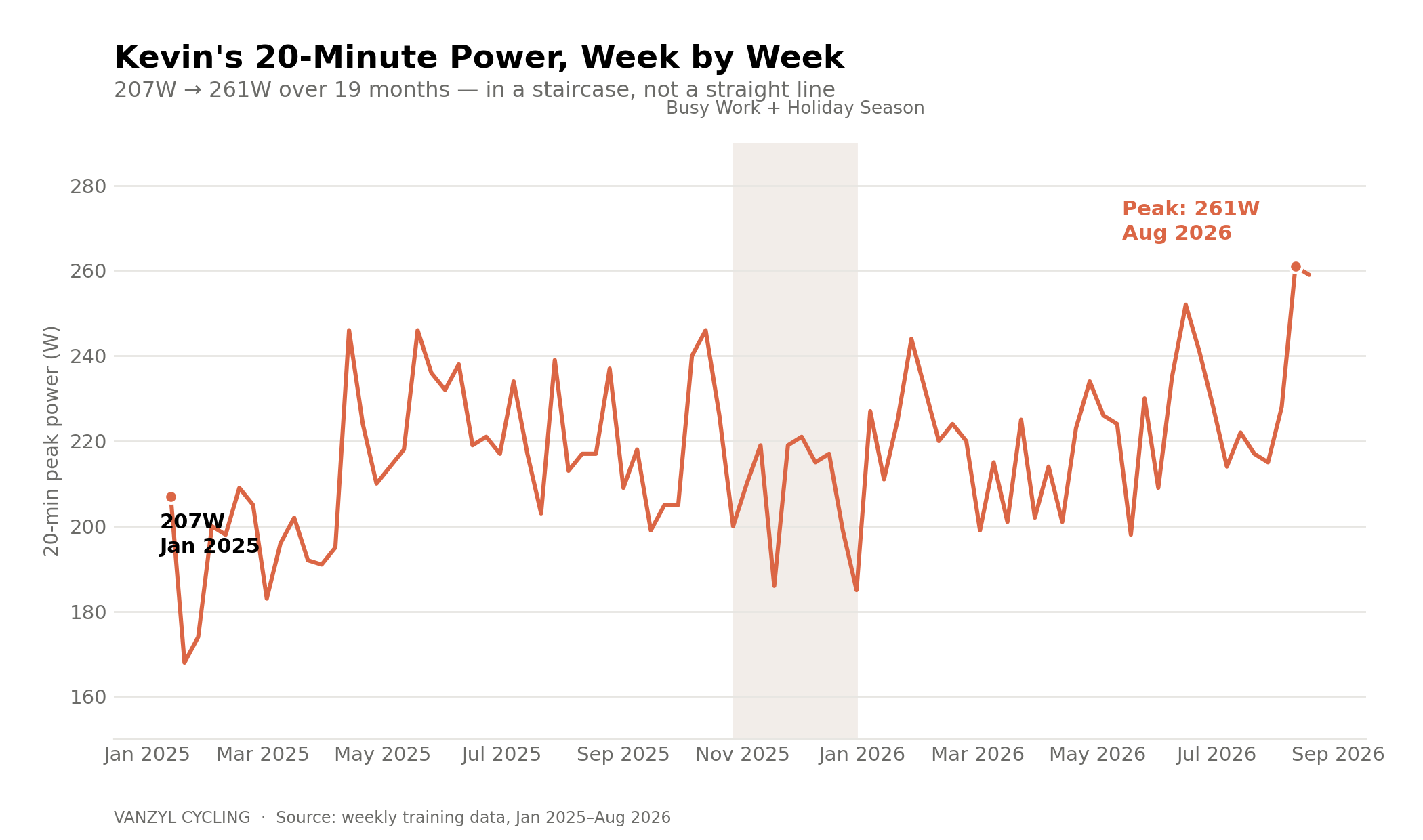
Look at that curve. It's a staircase, not a straight line. That's what real improvement looks like when you have a job and personal life.
I started coaching Kevin in January 2025. One of my core coaching principles is "do the basics right, consistently." There's no point worrying about how you will find the final 1% if you didn't lay the foundation. What classifies as basics? Well, for me: general endurance rides (ride your bike more!), high torque low cadence drills, good tempo sessions, over/under intro rides, learning how to judge an effort without staring at a power meter, fueling (on and off the bike), sleep, race day habits. As you can see, this list is pretty long, and I most probably left out a few. My point being, do the above consistently, learn how to listen to your body, and your power duration curve will improve.
Here's why the basics work, and it isn't magic. The engine behind your 20 and 60 minute power is aerobic: mitochondrial and capillary density, stroke volume, how well you burn fat at tempo. Those adaptations respond to how often you train and how much total time you put in, not to the occasional monster week. Train consistently and they stack on top of each other. Miss a week or two and you find yourself clawing back fitness you already bought instead of building new fitness on top of it. Kevin rarely did that. That's the whole game.
So, off the bat, Kevin got to work on the basics. Working with busy working professionals also means that as a coach, I have to adapt the week to their schedule. That may mean adding an extra transition day on Tuesdays because his demanding work simply won't allow for a quality session. We tried, and after a few sessions we quickly pivoted.
What does his week look like?
Monday: Easy spin + mobility work
Tuesday: 60 to 90 minute Z2 ride, long work day
Wednesday: Quality session, slightly more flexible working hours
Thursday: Transition ride, I leave this open to gravel, MTB, road, group ride, whatever he wants to do, long work day
Friday to Sunday: a solid 3 day block that starts with a key workout on Friday, long endurance on Saturday, and Sunday long again with some specifics
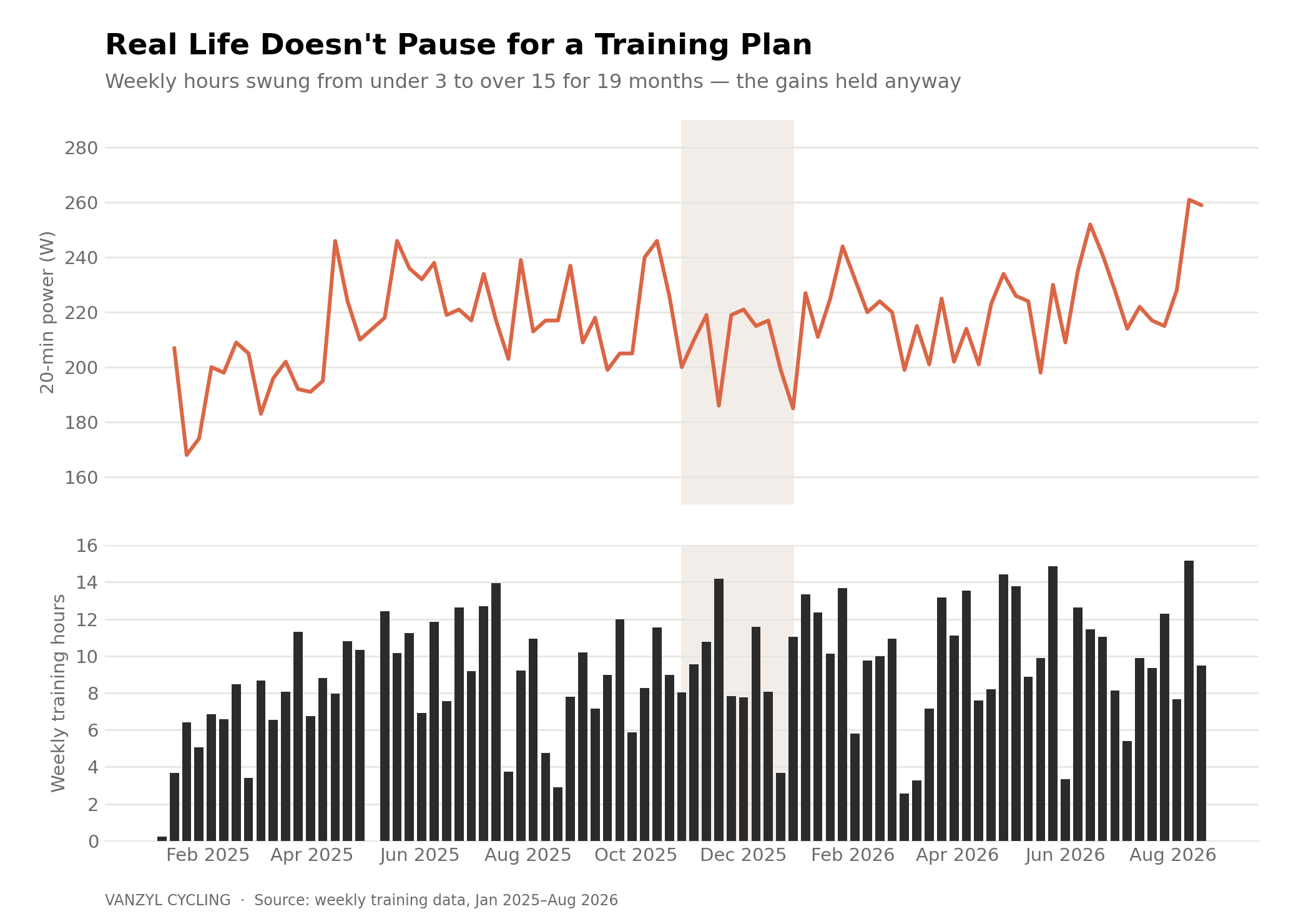
The chart above shows Kevin's weekly training volume in hours and his peak 20 minute power. As you can see, volume increased nicely off the bat, and his 20 minute power improved rapidly. Makes sense, right? Introduce a new stimulus, for Kevin that was working with a coach, and the body will adapt and get stronger. Kevin's volume cap is around 12 to 14 hours a week, and the chart shows that once we reached that plateau, the rate of improvement naturally slowed. Am I worried? Hell no. I also didn't make Kevin do weekly 20 minute max efforts, so a few of those “dips” were simply weeks without a 20-minute effort to feed the data. I track and monitor longterm trends, and those matter far more than any one week.
Now look at the black bars. This is the part I want you to sit with. Hardly ever did Kevin have multiple weeks at reduced volume, or a week at zero. Through a long winter, through the busiest stretches at the practice, through the holidays, he kept clipping in. That's not luck, and it's not talent. That's a decision he made over and over again. Will a 30 TSS spin get you +54W? No. But that spin sets the rider up for the key workout the following day. It keeps blood flowing and the legs turning over, so he shows up able to actually hit the targets that drive the adaptation. We all know the feeling of being off the bike for a couple of days, clipping in, lungs burning, HR pinned at Z3 power. That sucks. Kevin's refusal to let that happen is exactly what held his momentum.
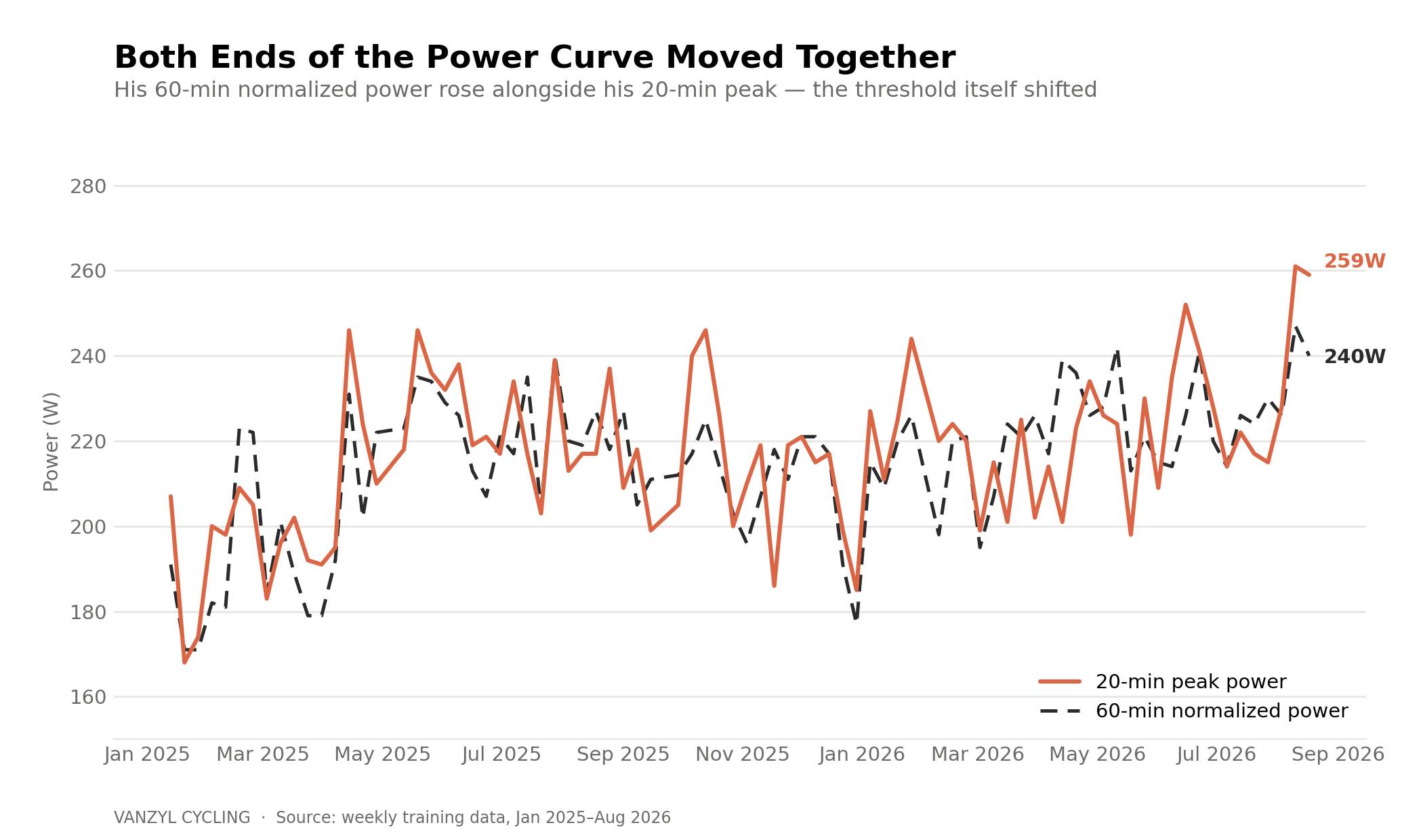
Now, you could easily argue that plotting a few good 20 minute efforts on a chart will naturally look like fitness improved, right? Well, let's add his 60 minute power. In conjunction with his 20 minute power, his 60 minute ceiling lifted too. That confirms his threshold followed the same step up path, and that his performance improved as a whole, not just his ability to hold a single 20 minute effort.
How did he achieve that? Basics. Torque training. Good tempo workouts. Over/Unders. Long climbs up to Jamestown and Ward. And when the time called to sharpen the knife: 40/20s, anaerobic capacity work, even sprints. This also shaved 40 minutes off his SBT100 7hr goal, finishing in 6:20. Kevin also recently finished 3rd overall at the Wyo131 and won his age category.
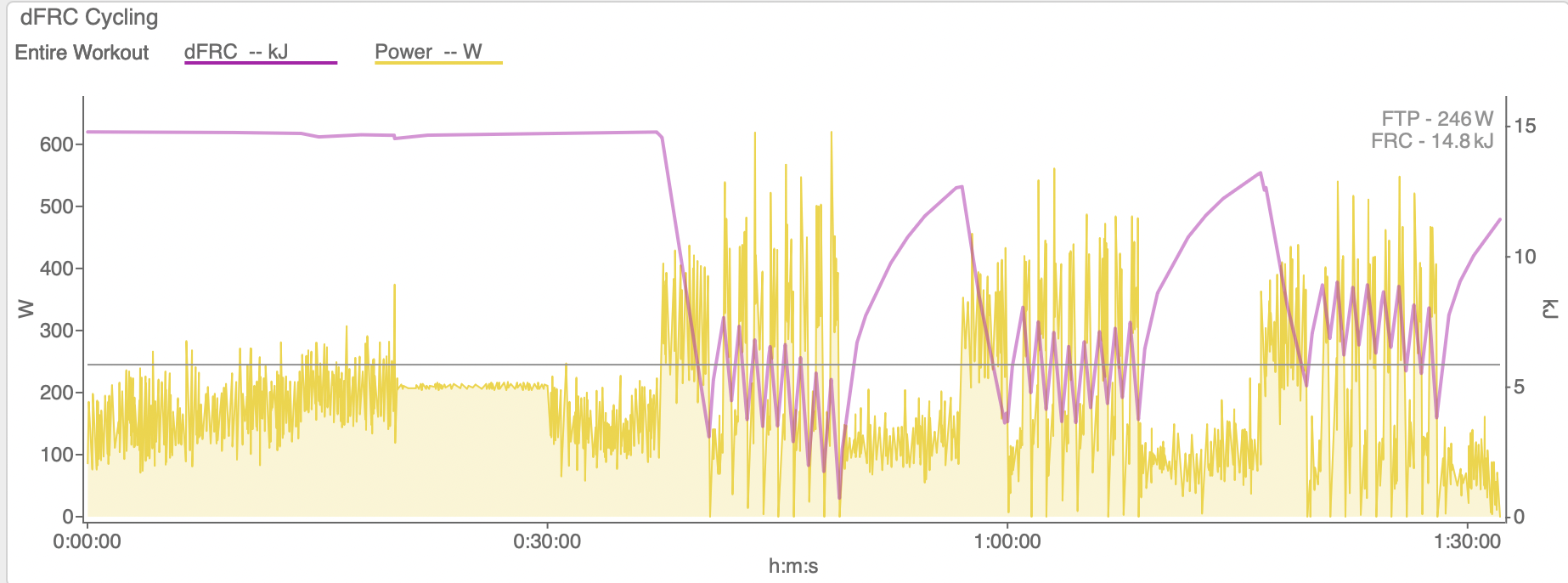
The chart above shows power (yellow) and W' (purple). This is an example of one of Kevin's key sessions. It's a short 2 to 3 minute steady VO2 effort, followed by a 1 minute recovery, straight into 30/30s. I like to use the short steady VO2 intro to get the rider up to VO2 max and deplete some of their W', and then perform 8 x 30 seconds on, 30 seconds off. Three sets. This helps them spend more time at VO2 during the 30/30s compared to going straight into the 30/30s cold.
Why share this?
Not to tell you that getting faster is easy. Kevin's 54 watts are proof of the opposite. He earned every one of them in the hours he refused to give up, on the days he was tired, in a calendar that had no room to spare. You don't need 20+ hour weeks to improve. You need to find your hours, protect them the way Kevin protects his, and put the right work in them consistently. Do that, and your performance will climb.
Kevin, well done. That's a hell of a build, and you did the hard part yourself.
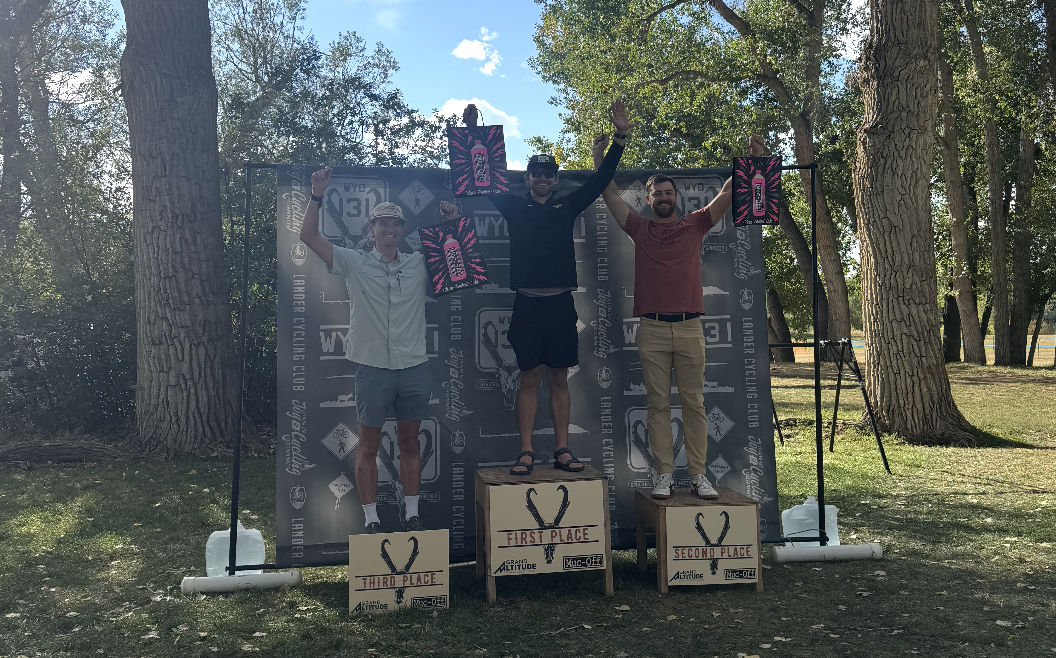
Wyo131, top step in his age category and third overall.