

Cycling Off-Season Training: How Much Rest Do You Actually Need?
The two reasons I put every athlete through an off-season, and why the right length depends entirely on the season you just finished.
The question I get every October
If I rest, will I lose everything?
It arrives in some form from almost every athlete I coach, usually within a week of their last race.
I still tell all of them to stop and take a break. Not because the fear is irrational, and I will come to the research on that further down, but because what you gain from a proper break is worth more than what you give up, and because most riders are giving up far less than they think.
When I was racing professionally, I took a minimum of three weeks off after Paris-Tours or Il Lombardia. No bike at all. And I still remember Bernie Eisel yelling at us in his deep Austrian voice, “Remember, it’s only November,” whenever somebody tried to push the pace or show off their form at our first training camp. That camp was really for meeting sponsors, planning the season, and getting to know new teammates rather than for training, and he was reminding us not to get ahead of ourselves.
Here are the two reasons I care about most, and neither of them is physical recovery. Rest repairs a tired body. That much is obvious. These two are the ones riders skip past.
Reason one: you cannot plan a new season while you are still living in the old one
An athlete who rolls straight from their last race into next year’s build is still training in reaction to how their previous season went. Reacting to the race that went wrong in June. Reacting to the form they had in August and want back. During those sessions, they are not thinking forward; they are replaying the past.
The break is what closes the old season so a new one can start. Two weeks with no structure and no obligation is enough time for the season to actually finish in your head, not just on the calendar. What I see afterwards is a shift from reviewing to visualising. The athlete stops relitigating the year and starts envisioning what they want next year to look like.
That shift matters more than any single workout you could have done in those two weeks. Plan next season the week after your last race and you will plan the same season again. Same races, same targets, just a bit more of everything. Give it two weeks, and you usually come back with a different answer. That is the version I can actually build a plan around.
Reason two: you need somewhere to build into
This is the one riders find hardest to accept, and it is the stronger of the two arguments.
Adaptation comes from progressive overload relative to where you currently sit. So consider a rider who holds a chronic training load of 120 all season, where 120 is genuinely their ceiling given the hours their life allows and the intensity they can tolerate. They are maxed out around 120. There are no more hours to add and no more intensity their week will absorb. They can still change what the load is made of, and a good coach will. What they cannot do is add to it.
What exactly is that rider going to progress into in January, if they spent October through December holding on to the CTL they like quoting on group rides?
If you arrive at the start of a new training year already sitting at or near your ceiling, you have no runway. The only lever left is pushing intensity on a system that has been loaded for eleven months, which is how riders end up training hard all winter and arriving at spring slower than they left.
Letting that number come down to 100, or 90, or even 80 is not losing fitness. It is restoring the capacity to progress. Now you have thirty or forty points of runway to build back through, and more importantly, you get to choose how you build it. That ramp is where the actual training happens. It is the only long uninterrupted stretch of the year where you can aim at a weakness for eight weeks without a race getting in the way, or spend real time sharpening what you are already good at.
It is also where the volume goes. Seiler and Tønnessen surveyed elite endurance athletes across running, cycling, rowing, cross country skiing and swimming and found that roughly 80 percent of their sessions sit below the lactate threshold, and suggested that large volumes of low intensity work may be what maximises the peripheral adaptations. You cannot accumulate that volume while sitting at your ceiling. You accumulate it on the way back up to one.
You will very likely be back at 120 by June, if not earlier. But you will arrive there having built it deliberately, on top of an athlete who is better constructed than the one who simply never let the number fall.
You have to come down before you can build back up.
How long your break should be
This is where most off-season advice goes wrong, because it gives one number to everybody. A rider racing forty days a year on fourteen or more hours a week has finished a completely different season to someone who raced four times on eight hours a week, and they do not need the same thing.
I raced ninety or more days a year back in the day, usually including a Grand Tour and several week-long stage races, and that required a very different off-season to a rider doing forty days on the US domestic circuit. All of it has to be taken into account. No blanket template works for every athlete, at least not for the ones I coach.
Scale the break to the season you just finished. These are starting points I use with athletes, not durations the research has established, and I move them around depending on how the season actually went.
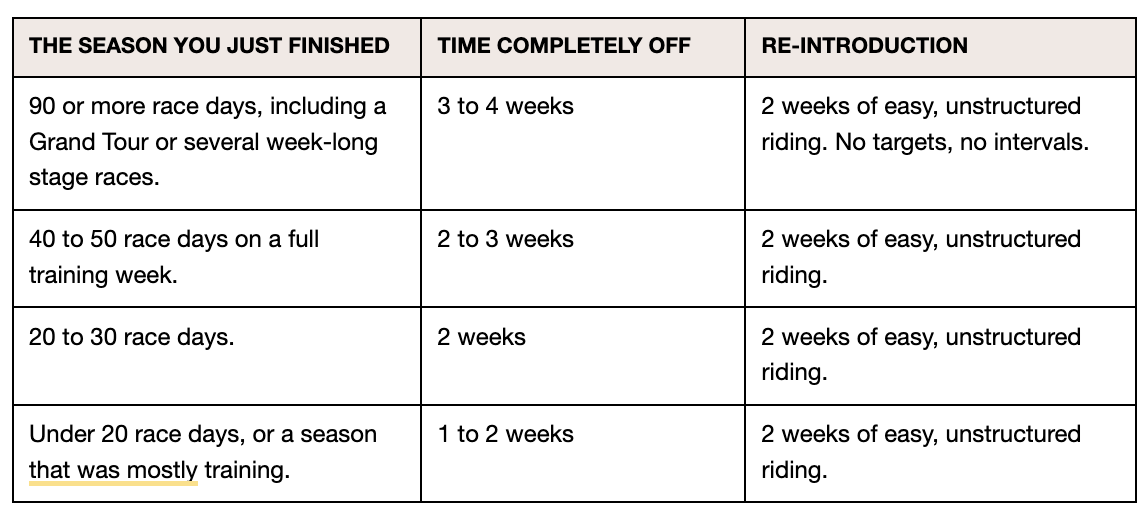
Two things about that table.
Those are minimums, not targets. If you finish the season ill, injured, or simply sick of the bike, take longer. Nobody has ever come to me in March and said the problem was that they rested too much in October.
Completely off means completely off. Not easy riding, not a coffee spin, not a commute. Go and do something else entirely. This is the part amateurs negotiate with, and it is the part that does the work, because what you are waiting on is not a physiological adaptation. It is the return of the appetite to train.
The re-introduction that follows is deliberately vague, and that is the point. Ride when you want to, for as long as you feel like, with no targets on the screen. If you want to go hard up a climb with friends, go hard. If you want an hour and then home, go home. That fortnight lets you get your rhythm back without turning riding into a job again, and it carries no training stress worth worrying about. Do not try to win back your two lost weeks by going overboard in the re-introduction.
An off-season is not the same thing as detraining
Worth separating these, because they get used as if they were one thing. Detraining is a physiological outcome. It is what happens when training drops below the level needed to hold an adaptation. An off-season is a decision you make. You can take one while deliberately letting some fitness go, and most of the time that is the point of it.
There are four different things sitting under the same word. Complete rest is no cycling at all. Free riding is cycling with no training objective. Reduced training is less load but still structured. Detraining is the physiological consequence when any of those goes on long enough. The plan below uses the first two on purpose, and for long enough to be useful without running into the third.
So the goal is not to protect every adaptation you had in September. It is to decide which ones are worth rebuilding for next season.
What the research actually says, and the part everyone misreads
The fear of losing fitness has a real evidence base behind it, and the numbers are genuinely alarming. In Mujika and Padilla’s review of training cessation, VO2max falls between 4 and 14 percent in highly trained athletes within weeks. Plasma volume drops 5 to 12 percent, and some of that happens inside the first two days. Stroke volume falls 10 to 17 percent after 12 to 21 days. Citrate synthase activity, a reasonable proxy for how well your mitochondria are working, falls 25 to 45 percent.
That is the data riders quote when they do not want to stop. Read in isolation, it makes a compelling case for never getting off the bike.
Two things about it.
First, those figures describe complete training cessation sustained over time. That review covers layoffs of up to four weeks, and the upper end of each range belongs to the long end of that window rather than to a fortnight. My reading is that a one- to two-week break sits at the gentle end of it all, though that is my judgement rather than something the paper states.
Second, and more useful, the changes you actually feel in that first week are the ones that reverse fastest. That heavy, breathless sensation on your first ride back is largely plasma volume, and plasma volume responds to a handful of training sessions. Heart rate settles with it. Meanwhile the things that took you years to build barely move. Capillary density stays well above untrained levels, and muscle fibre type distribution holds, even though fibre cross-sectional area can start to give. The adaptations that took you years to build are not wiped out by a fortnight away from structure.
So yes, physiologically, a two-week break costs you something. What it costs is roughly the two weeks of easy riding that follow it, which is exactly what the re-introduction period is for.
Signs you need the longer end of the range
Your chronic training load has been drifting down for months while you kept training. That is not a taper. It means the work you are putting in is no longer enough to hold the fitness you already built.
Your numbers stopped responding in the back half of the season. Same work, same fuelling, no movement.
Your heart rate will not come up in hard efforts, or it sits high on easy ones.
You got sick more than once, or you are sleeping badly.
You are not looking forward to riding. Coaches undersell this one because it is not a number, but across a roster it predicts the next twelve weeks better than most of the numbers do.
The honest counter-argument
There is a respectable position that the weeks after your final race are the best window you will get for working on limiters, because you still have race fitness and none of the race pressure. Train through it, the argument goes, and you start your base period from a higher floor.
For the right athlete, that is correct. A rider who raced a light calendar, finished healthy, has one clear limiter and is still hungry will get more from a structured block than from a month of nothing, especially if their season wrapped up in early September.
The problem is that most riders reading that advice are not that athlete. The two mistakes also do not cost the same. Take a break you did not strictly need, and you give up a few weeks that you will have back within a month of starting base. Skip one you did need and you spend the next season chasing a power number that never comes.
When in doubt, rest.
One variation I use
There is a version of this I run with athletes who finish early, and it exists mostly because nobody wants to sit inside watching a perfect 65 degree October Saturday go to waste. Autumn temperatures and the leaves turning deep red are half the reason we ride here.
So we reverse the order. Two to three weeks of genuinely free riding first. Group rides, chasing Strava segments, whatever they feel like. Then the official break once the weather turns and there is less to miss.
We skip the re-introduction at the far end, because the free riding already did that job, and go straight into base. Same two components, same total length, just ordered to suit the calendar and the athlete rather than the other way round.
What to do in the next two weeks
Stop racing. That autumn event you are half committed to is not worth what it will cost you.
Start the break now rather than in December, when the weather makes the decision for you and you arrive at base training having rested badly for three months instead of properly for two weeks.
Before you switch off, pull the full season picture while it is still fresh. Your chronic training load across the year, your power duration curve against last season, your weight, your sleep, your illnesses and your crashes. This is the one week of the year when you can see the whole shape of what happened, and it is what next year’s plan gets built from.
Book the things that are not training. A bike fit. Blood work. The physio appointment you have moved four times.
Then decide what next season is actually for, before you start building towards it.
The point, in one line
The athletes who improve year on year are not the ones who train hardest in October. They are the ones who arrive in January with a clear head and somewhere to build into.
Take the off-season. Then come back and build something.
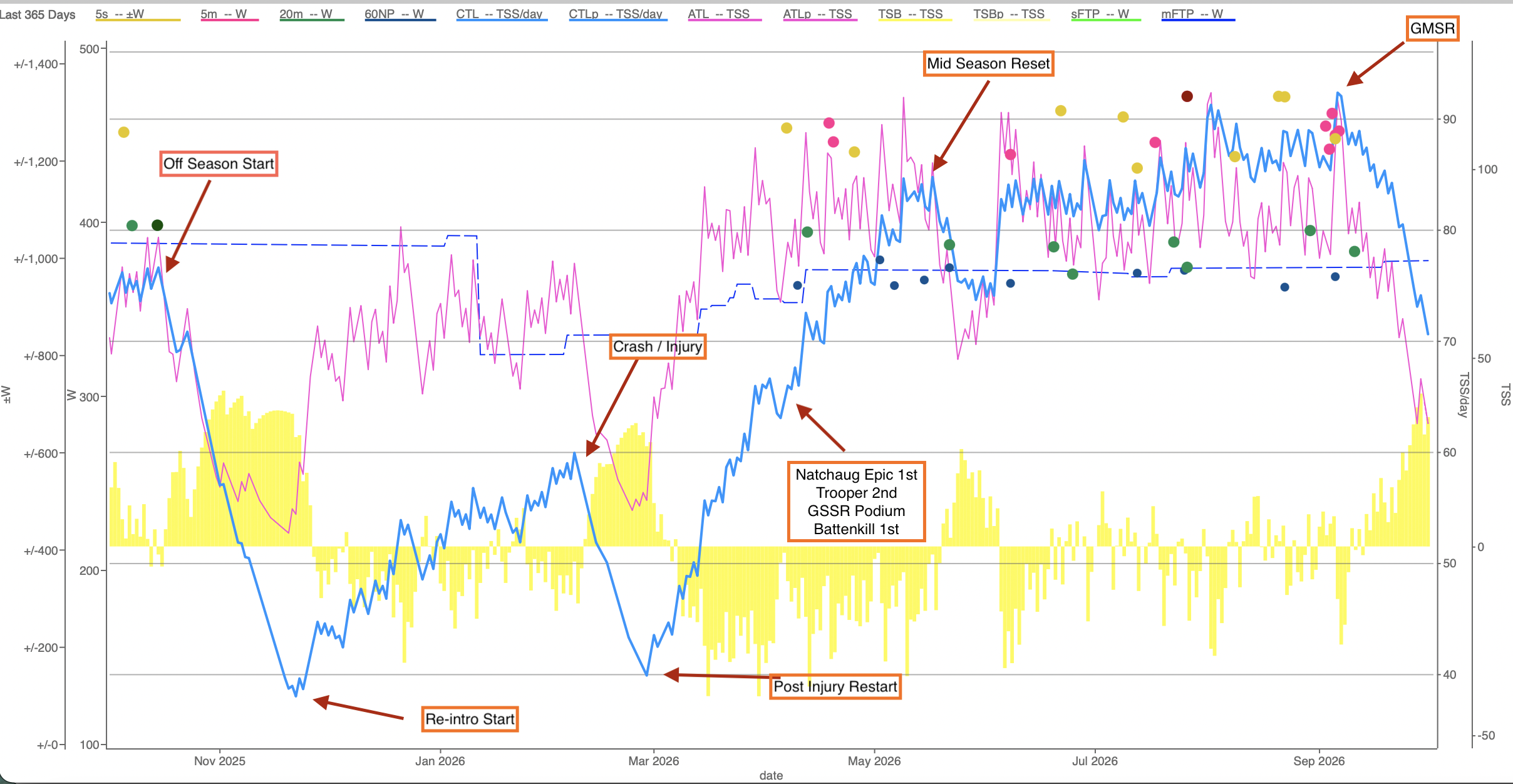
One of my athlete's season, October 2025 through September 2026. The first drop is the off-season, taking CTL from around 80 into the low 40s by late November, with the re-introduction starting at the bottom of it. The climb out runs three months until a crash in late February takes six weeks and twenty points off him. The second rebuild is steeper than the first, and the wins sitting on top of it are Natchaug Epic and Battenkill. He finished the year at his highest chronic training load of the season, in September, at Green Mountain.
Reference
Mujika I, Padilla S. Detraining: loss of training-induced physiological and performance adaptations. Part I: short term insufficient training stimulus. Sports Medicine, 2000.
Seiler S, Tønnessen E. Intervals, thresholds, and long slow distance: the role of intensity and duration in endurance training. Sportscience, 13, 32-53, 2009.
Johann van Zyl raced six seasons as a professional in Europe, including four Grand Tours and five Monuments, and now coaches cyclists from Boulder, Colorado.