

Masters Cycling Training: How to Train Smarter After 40
The training plan that worked at 28 won't work at 45. Here's what actually changes after 40 -- and the specific adjustments that will make you faster without wrecking your body or your life.
Let me be direct with you: the training plan that made you fitter at 28 will break you at 45.
I've watched it happen. An athlete comes to me having trained hard for years; long rides, big weeks, plenty of suffering. They're motivated. They're consistent. And they're stuck, frustrated, or injured. Sometimes all three.
I raced professionally for eight years, including four Grand Tours with Team Dimension Data. I've trained alongside riders who peaked at 36, 38, 40. I've also watched talented athletes burn out in their early 30s because they never adjusted how they trained as their physiology changed.
Now I coach masters athletes, riders who have jobs, families, and real lives outside the sport, who want to race faster and feel better doing it. Here's what I've learned about training after 40 that most programmes get wrong.
What Actually Changes After 40
The physiology is real. Ignoring it doesn't make you mentally tough; it makes you injured and overtrained. Here's what's happening:
Recovery takes longer
This is the big one. The gap between a hard session and being ready for the next hard session widens as you age. A 25-year-old might recover from a threshold session in 24 hours. At 45, that same session might need 48-72 hours of quality recovery. Your body isn't weaker; it's just slower to rebuild.
The fix: Less frequency of hard sessions, more quality per session. Three well-recovered hard days beat five half-recovered ones every time.
Hormonal environment shifts
Testosterone and growth hormone are both critical for training adaptation, and decline with age. This affects how quickly you build fitness, how well you absorb training load, and how long it takes to recover from injury.
The fix: Sleep becomes non-negotiable. Eight hours is a training tool, not a luxury. Strength work twice a week supports hormonal health in ways that cycling alone cannot.
Muscle fibre composition changes
Type II muscle fibres, the fast-twitch fibres responsible for explosive power and sprint capacity, decline more rapidly with age than Type I endurance fibres. This is why masters sprinters fade faster than masters rouleurs.
The fix: Don't abandon high-intensity work, but do it with full recovery. Short, sharp intervals maintain fast-twitch fibres. Weekly long slow rides alone won't.
Connective tissue adapts more slowly
Tendons and ligaments respond to training stress more slowly than muscle tissue at any age, but this gap widens after 40. Most overuse injuries in masters athletes aren't muscular. They're connective tissue failures caused by ramping training load too fast.
The fix: Slow the ramp rate. Build volume and intensity over months, not weeks. The 10% rule, no more than 10% increase in weekly load, is conservative for masters athletes. I often use 7% with the athletes I coach.
The Biggest Mistake Masters Cyclists Make
They train in the middle. Always.
Moderate intensity, moderate volume, moderate recovery. Every ride is reasonably hard, nobody is ever fully fresh, and nobody is ever truly stressed. The body gets a consistent moderate stimulus and plateaus.
In the professional peloton, we called it 'no man's land.' The zone where you're too tired to go hard enough to adapt, and too stimulated to recover properly. It produces a very specific type of fitness, one that looks great on paper and doesn't translate to race performance.
The research on this is well established. Dr. Stephen Seiler -- widely recognised as the father of polarised training - has demonstrated repeatedly that endurance athletes perform best on a polarised model: roughly 80% of training at genuinely easy intensity, 20% at genuinely high intensity, with almost nothing in the middle. The problem for masters athletes is that the easy is rarely easy enough, and the hard rarely happens because nobody has the energy.
How to Structure a Masters Training Week
Here's a realistic framework for a masters cyclist training 8-12 hours per week. This is built around the polarised model with a nod to the real-world demands of life after 40.
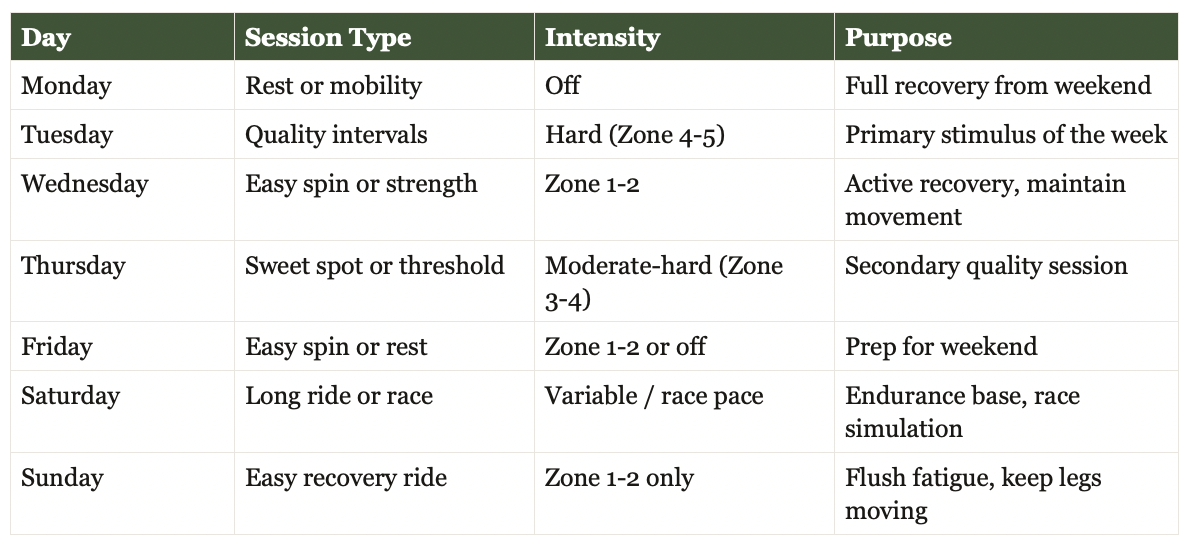
This isn't prescriptive, it's a framework. Your week looks different based on your commute, your family schedule, and your race calendar. But the principles hold: two quality sessions maximum, genuine recovery around them, and easy really means easy.
Strength Training Is Not Optional After 40
I used to think strength training was for triathletes and off-season box-ticking. During my racing days, strength training for cyclists wasn’t as popular as it is now, and I wish I knew more about it back then. I would have approached my training entirely differently and incorporated strength training throughout my entire career.
After 40, the case for strength work becomes physiologically irrefutable. You're losing muscle mass at a measurable rate, roughly 3-5% per decade from age 30, accelerating after 50. Cycling alone does not stop this. It preserves cardiovascular fitness and endurance capacity. It does very little for upper body and core strength, and it underloads the fast-twitch muscle fibres that decline fastest with age.
The athletes I coach who commit to twice-weekly strength sessions, 30-40 minutes, focused on compound movements, see a much slower, if any at all, if I’m being honest, power decline from two or three years prior. It's not a coincidence. The strength gains translate directly to climbing power, TT position endurance, and the ability to attack and recover in the final hour of a race.
What to prioritise in the gym
Foundation: Heavy single-leg work
Bulgarian split squats, single-leg press, step-ups. Replicates the asymmetric loading of cycling while building strength and hip stability.
Power development: Hip hinge patterns
Deadlifts, Romanian deadlifts. Builds posterior chain strength that translates directly to climbing power and TT position endurance.
Injury prevention: Core stability
Not crunches. Anti-rotation work, dead bugs, Pallof presses. The core that matters on a bike resists movement; it doesn't create it.
Posture and position: Upper body pulling
Rows, pull-ups, face pulls. Counteracts the forward hunch of hours in the drops and prevents the shoulder and neck issues that plague masters cyclists.
The Recovery Protocol That Actually Works
Recovery after 40 isn't just taking it easy on the bike. It's a set of deliberate practices that determine how much of your training you actually absorb.
Sleep is the only thing that matters more than training
I'm serious. Chronic sleep deprivation, under seven hours regularly, suppresses growth hormone release, impairs glycogen resynthesis, elevates cortisol, and reduces reaction time. You cannot out-train bad sleep. Not at 25. Not at 45.
Nutrition timing matters more than it did
The anabolic window, the period immediately after training where your body is primed to absorb protein and carbohydrate, is real, and it narrows with age. Masters athletes who eat within 30-45 minutes of finishing a hard session recover measurably faster than those who wait.
Practical target: 20-30g of high-quality protein and 40-60g of carbohydrate within 30 minutes of finishing a quality session. A protein shake with a banana is sufficient. The window matters more than the source.
Periodisation: planned easy weeks - are not a weakness
Every fourth week in my athletes' plans is a reduced load week. Not easy, reduced. 40-50% of normal volume, intensity maintained. This is where adaptation happens. Skipping easy weeks to 'stay consistent' is the most common reason masters athletes plateau. Masters cyclists need explicit recovery weeks built into the plan, not improvised when they finally feel too tired to continue.
What Masters Cyclists Should Actually Race
Race selection matters more after 40 than it did when you could recover from a punishing race in two days.
I encourage the athletes I coach to be strategic about their race calendar. Choose a target event, build toward it, and treat the rest of the calendar as either preparation or controlled suffering, not all-out performance every weekend.
The masters athletes I've seen perform best long-term are those who pick their moments, arrive prepared, and leave having raced intelligently. Not those who race every weekend and wonder why they're always tired.
The Bottom Line
Training smarter after 40 isn't about doing less. It's about doing the right things with full commitment and genuine recovery between them.
Two quality sessions per week, properly recovered. Strength work twice a week. Easy rides that are actually easy. Sleep as a training tool. A race calendar you're building toward, not grinding through.
The masters athletes I coach who follow these principles consistently, not perfectly, but consistently, get faster. Not despite being over 40. Often because of the discipline and self-awareness that comes with it.
Your best years on the bike may still be ahead of you. I've seen it happen more times than I can count.
Frequently Asked Questions
-
The best plan for masters cyclists follows a polarised model, most training at genuinely easy intensity, with two quality sessions per week at higher intensity. This approach is supported by extensive research from Dr. Stephen Seiler and now forms the basis of coaching education programmes worldwide. Recovery should be longer than it was in your 30s, and strength training twice weekly is essential, not optional.
-
Yes, significantly. Masters athletes I coach routinely improve FTP by 10-18% in their first coached year, particularly those coming from unstructured training backgrounds. Improvement slows but does not stop with age. Joe Friel's masters athlete research, available through TrainingPeaks and his Training Bible series, consistently shows meaningful fitness gains in athletes well into their 60s and 70s when training is properly structured.
-
After 40, strength training shifts from optional to essential. Without it, masters cyclists lose 3-5% of muscle mass per decade and accelerate fast-twitch fibre decline. Two 30-40 minute sessions per week of compound movements; single-leg work, hip hinge patterns, core stability, upper body pulling, protect against this and translate directly to power on the bike.
-
Recovery from a quality session typically takes 48-72 hours for masters athletes, compared to 24 hours for cyclists in their 20s. This is the single biggest factor most masters cyclists fail to account for in their training. Three principles drive proper masters recovery: sleep prioritisation, nutrition timing within the 30-minute anabolic window, and structured easy days, all planned, not improvised.
-
Polarised training, also called 80/20 training, is a model where roughly 80% of training is done at low intensity (Zone 1-2, easy aerobic) and 20% at high intensity (Zone 4-5, hard intervals), with almost nothing in the middle. The model was developed by Dr. Stephen Seiler based on his research with elite endurance athletes and is now considered the gold standard for endurance training across cycling, running, triathlon, and cross-country skiing.
-
Sweet spot (typically 88-93% of FTP) remains a useful training stimulus for masters athletes, but should be used carefully. I use sweet spot work as a secondary stimulus in masters athletes' weeks, not as the primary training driver, because the cumulative fatigue from too much sweet spot can prevent the high-quality sessions where real adaptation happens. One sweet spot session per week, alongside one true threshold or VO2 session, is the formula I see produce the best results.